

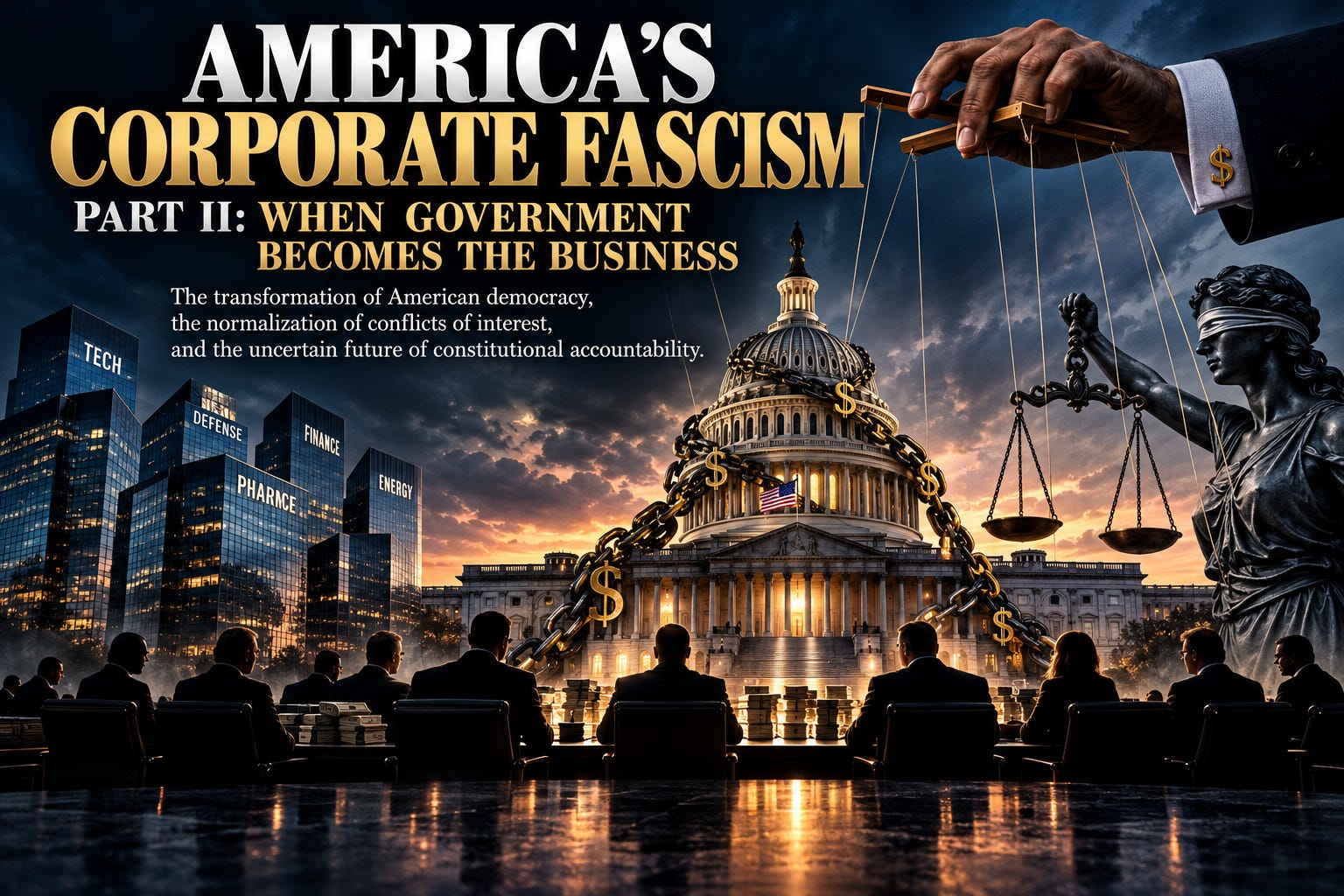
America’s Corporate Fascism, Part II: When Government Becomes the Business
The transformation of American democracy, the normalization of conflicts of interest, and the uncertain future of constitutional accountability.
Introduction: The Animal Is Out of the Cage
On November 14, 2024, I published an article titled America’s Corporate Fascism, examining the historical convergence of corporate wealth and political power in the United States.
At the time, my concern was that American democracy had gradually evolved into a political economy in which corporations exercised disproportionate influence over government decisions.
Nearly two years later, that concern has taken on a new dimension.
The question is no longer simply whether corporations influence government. It is whether government itself is becoming an instrument through which political insiders, their families, and favored business interests can accumulate economic power.
Historically, much of this influence operated through lobbyists, campaign financing, political action committees, and relationships that remained largely invisible to ordinary citizens.
Today, some of those relationships are conducted openly, defended publicly, and increasingly presented as ordinary features of political leadership.
What happens to a democracy when the appearance of conflicts of interest no longer produces meaningful political consequences? And perhaps more importantly, what happens when the public begins accepting such arrangements as normal?
The danger is not simply that the boundaries between government and private wealth are being tested. It is that Americans may be losing their expectation that those boundaries should exist at all.
1. From Corporate Influence to the Commercialization of Political Power
The traditional model of corporate political influence was relatively straightforward.
Corporations sought favorable legislation, government contracts, tax advantages, and regulatory treatment. They invested in lobbying operations and political relationships to improve their chances of achieving those outcomes.
Government officials, at least in principle, were expected to maintain a separation between their public responsibilities and private financial interests.
That separation has never been perfect. American history contains numerous examples of corruption, patronage, and regulatory capture.
But the second Trump administration has brought renewed attention to a particularly troubling possibility: political authority and private commercial opportunity becoming closely intertwined within the same network of individuals and institutions.
The Trump family’s cryptocurrency ventures, the president’s continuing financial interests, and the business relationships of individuals involved in foreign diplomacy have raised substantial questions about conflicts of interest.
These circumstances do not automatically establish criminal wrongdoing. But democracy depends on more than the absence of criminal convictions.
It also depends on public confidence that decisions are being made for the national interest rather than private enrichment.
When citizens cannot distinguish between a government decision and a business opportunity for someone connected to that government, institutional legitimacy begins to deteriorate.
This represents an important evolution of the argument I made in 2024.
Corporate influence traditionally involved private interests seeking access to public power. The emerging concern is that access to public power itself may increasingly become a source of private economic advantage.
2. The Presidency and the Expansion of Executive Power
One of the most consequential developments occurred before Trump’s second inauguration.
On July 1, 2024, the Supreme Court decided Trump v. United States, establishing absolute criminal immunity for presidential conduct within exclusive constitutional authority, presumptive immunity for other official acts, and no immunity for unofficial acts.
The decision did not place the president entirely above the law. It did not eliminate impeachment, judicial review, or every other mechanism of constitutional accountability.
However, it substantially changed the framework for holding former presidents criminally accountable for actions undertaken while exercising official authority.
The implications extend far beyond Donald Trump. Every future president inherits the constitutional powers and legal precedents established by previous administrations.
A democracy cannot rely indefinitely on the expectation that its leaders will voluntarily exercise restraint. Constitutional government requires enforceable limits, independent institutions, and officials willing to defend those limits.
The Constitution remains the foundation of American government. But its practical effectiveness depends on how its provisions are interpreted, implemented, and enforced.
A constitutional safeguard that cannot be enforced when politically inconvenient risks becoming a principle without an effective remedy.
The question is not whether the Constitution still exists. It is whether the institutions responsible for enforcing it remain sufficiently independent, capable, and willing to do so.

3. From Theory to Reality: Five Developments That Reveal the Changing Relationship Between Wealth and Government
When I published America’s Corporate Fascism in November 2024, the central argument was that corporate wealth had acquired disproportionate influence over American democracy.
Developments during 2025 and 2026 have provided new reasons to examine that argument.
Five examples illustrate how the boundaries between public authority, private financial interests, and political relationships are being tested.
A. Cryptocurrency and Foreign Investment: The $2 Billion Connection
In May 2025, Abu Dhabi-backed investment firm MGX selected USD1, a stablecoin associated with the Trump family’s World Liberty Financial venture, for its $2 billion investment in cryptocurrency exchange Binance.
The transaction did not represent a direct $2 billion payment to the Trump family.
However, it placed a financial product associated with the president’s family at the center of a major international transaction.
The arrangement raised questions about the potential financial benefits of increased demand for USD1, the relationship between foreign investors and politically connected businesses, and the adequacy of existing conflict-of-interest safeguards.
The central issue is not whether cryptocurrency is inherently corrupt. Cryptocurrency and blockchain technologies have legitimate financial and technological applications.
The concern emerges when individuals connected to government authority maintain private financial interests in industries directly affected by government policy.
A president’s regulatory decisions can influence the value, legitimacy, and commercial opportunities of entire industries.
When the president’s family simultaneously participates in those industries, the public deserves clear information about ownership, financial benefits, and safeguards against improper influence.
Source: Reuters, May 1, 2025.
B. Government Becomes a Corporate Shareholder: Intel
On August 22, 2025, Intel announced an agreement under which the United States government would invest approximately $8.9 billion in exchange for a 9.9% ownership stake in the company.
The arrangement relied substantially on previously awarded federal funding commitments under semiconductor and national-security programs.
The administration presented the agreement as a strategy to strengthen American semiconductor manufacturing, technological competitiveness, and national security.
Intel described the government’s ownership as passive, without board representation or ordinary governance rights.
Government investment in strategic industries is not unprecedented, nor is it inherently authoritarian. During periods of economic crisis and national-security concern, American governments have repeatedly intervened in private markets.
The deeper question concerns the rules governing those interventions.
When government simultaneously acts as regulator, customer, policymaker, and shareholder, potential conflicts arise.
Who determines which corporations receive support?
What prevents political favoritism?
How are taxpayers protected?
And what independent oversight ensures that investment decisions advance national interests rather than political relationships?
Government participation in industry can serve legitimate public purposes. But its legitimacy depends on transparency, accountability, and consistent standards.
Source: Intel Corporation, August 22, 2025; SEC Form 8-K.
C. Corporate Donations to a Presidential Project: The White House Ballroom
In October 2026, a Washington Post investigation identified approximately $333 million in private commitments to President Trump’s White House ballroom project.
According to the reporting, Apple and Nvidia each committed $25 million. Other major contributors included technology companies, federal contractors, wealthy investors, and individuals with substantial interests before the federal government.
The investigation also identified at least $77 million in commitments from donors who requested anonymity.
The White House defended the private funding arrangement, arguing that corporate and individual contributions would help improve the White House while reducing the burden on taxpayers.
Contributors who commented denied that their donations were connected to favorable government actions.
The investigation did not establish that the contributions were exchanged for government favors.
Nevertheless, the arrangement raises significant questions.
Would an ordinary American citizen enjoy the same opportunities for access and influence as a corporation capable of contributing $25 million to a presidential initiative?
When participating corporations simultaneously depend on federal contracts, regulatory approvals, or other government decisions, how can the public determine whether those decisions were made exclusively in the national interest?
Corporate donations to public projects are not inherently improper.
But transparency becomes essential when the recipients of government decisions are also substantial financial supporters of projects associated with the president.
The absence of proven criminal conduct does not eliminate the responsibility to prevent conflicts of interest or the appearance of preferential treatment.
Source: The Washington Post, October 15, 2026.
D. Presidential Investments and Pharmaceutical Policy
In October 2026, congressional Democrats released an analysis reporting that President Trump’s pharmaceutical stock holdings had increased substantially.
According to their findings, the maximum disclosed value of those holdings rose from approximately $1.7 million in 2024 to as much as $56.2 million by the end of 2025.
The analysis identified investments in companies that benefited from provisions of the 2025 tax and spending legislation expanding exemptions from Medicare drug-price negotiations.
The White House rejected allegations of conflicts of interest, maintaining that the president does not control investment decisions in his independently managed portfolio.
The congressional findings do not independently establish that government policy was designed to benefit the president financially.
However, they illustrate the difficulty of maintaining public confidence when a president’s investments overlap with industries directly affected by his administration’s policies.
The problem is not limited to pharmaceutical companies.
It applies wherever government officials or their families maintain significant financial interests in sectors shaped by public decisions.
Financial disclosures, independent management, and enforceable ethics standards are intended to reduce these risks. But the effectiveness of those safeguards depends on whether they provide genuine separation between public responsibilities and private financial incentives.
Source: Associated Press, October 16, 2026, reporting on the congressional Democratic analysis.
E. Private Investment and Public Diplomacy: Jared Kushner
On October 14, 2026, Citizens for Responsibility and Ethics in Washington filed a lawsuit challenging Jared Kushner’s diplomatic role in the Trump administration.
Kushner, the president’s son-in-law, has participated in significant diplomatic initiatives while continuing to lead Affinity Partners, an investment firm supported by substantial foreign capital.
The organization argues that his responsibilities require Senate confirmation and financial disclosures.
These legal assertions remain subject to judicial determination.
The broader ethical concern, however, extends beyond the outcome of any individual lawsuit.
Should individuals conducting sensitive international diplomacy simultaneously maintain private financial relationships with foreign governments and investors potentially affected by American foreign policy?
What safeguards are necessary to ensure that diplomatic decisions are guided exclusively by national interests?
And how can the public evaluate those safeguards without adequate disclosure?
The legitimacy of diplomacy depends not only on the results it produces, but also on public confidence in the independence of those negotiating on behalf of the nation.
Source: Citizens for Responsibility and Ethics in Washington, October 14, 2026.
What These Five Cases Reveal
None of these examples, standing alone, proves that the United States has become a fascist state or that every transaction involved corruption. Some involve established financial arrangements. Others involve disputed allegations, ethical questions, or unresolved legal proceedings.
They should not be treated as interchangeable.
Collectively, however, they demonstrate why the relationship between government authority and private wealth deserves renewed scrutiny.
In 2024, my concern was that corporate influence had become embedded in American government.
In 2026, the more urgent question is whether the commercialization of political power is becoming an openly accepted feature of governance.
If so, the danger extends beyond one president, one political party, or one administration.
It becomes a precedent that future generations of political leaders may inherit, expand, and eventually regard as normal.
And that is how institutional boundaries can weaken without ever being formally abolished.
4. The Constitution: Stronger on Paper Than in Practice?
Perhaps the most unsettling lesson of recent American political history is that constitutional protections do not operate automatically.
A written Constitution establishes powers, limitations, and institutional responsibilities.
But a functioning constitutional democracy also depends on courts capable of reviewing government conduct, legislators willing to exercise oversight, public servants who follow lawful procedures, and citizens who demand accountability.
The American system was designed around checks and balances.
Yet those checks become less effective when institutional loyalty is replaced by personal loyalty, oversight becomes primarily partisan, or public officials face few consequences for ethical misconduct.
This does not mean the Constitution has collapsed.
Courts continue to hear challenges, elections continue to occur, and government decisions remain subject to legal and political contestation.
But it does mean that Americans should reconsider an assumption many have taken for granted:
That the existence of constitutional protections guarantees their effective enforcement.
The strength of a constitutional system must be measured not only by the rights it declares, but also by its ability to enforce those rights against powerful individuals.
The Founders understood that concentrated power presented a danger to republican government. Their constitutional framework divided authority among institutions precisely because no individual or faction could be trusted with unlimited power.
Yet the system also requires those institutions to exercise their responsibilities.
When Congress declines to investigate, when oversight becomes subordinated to partisan loyalty, or when public officials disregard established ethical expectations, constitutional protections can weaken in practice even while remaining intact in law.
This is why democratic accountability cannot depend exclusively on the personal character of whoever occupies the presidency.
A durable republic must remain capable of restraining leaders even when they possess substantial political support.
5. From Corporate Oligarchy to a System of Political Patronage?
The term corporate fascism is provocative, and it requires careful definition.
Historically, fascism refers t o authoritarian political movements and systems characterized by extreme nationalism, suppression of opposition, and the subordination of institutions to centralized political authority.
Corporate influence alone does not establish fascism.
More precise concepts for understanding particular aspects of the contemporary American situation include oligarchy, plutocracy, regulatory capture, crony capitalism, and patrimonial governance.
Oligarchy describes political influence concentrated among a relatively small elite.
Plutocracy emphasizes the dominance of wealth.
Regulatory capture occurs when institutions responsible for protecting the public become disproportionately responsive to the industries they oversee.
Crony capitalism describes economic advantages distributed through political relationships rather than open competition.
Patrimonial governance describes systems in which public authority becomes closely associated with the personal interests and relationships of political leaders.
These concepts are not identical, and their application to the United States remains a matter of analysis and debate. But the danger is that the tendencies they describe can reinforce one another.
If political access becomes a competitive advantage, corporations may increasingly invest in political relationships rather than innovation.
If government benefits become dependent on personal loyalty, independent institutions may lose influence.
And if citizens conclude that public policy is primarily a mechanism for enriching powerful networks, trust in democratic government may continue to decline.
The United States does not need to formally abandon elections or constitutional institutions for these developments to become consequential.
A democracy can retain its familiar structures while the practical distribution of influence changes substantially.
The critical question is whether citizens continue to possess meaningful opportunities to influence decisions affecting their lives, or whether those opportunities increasingly depend on wealth and proximity to political power.
6. What Happens When the Animal Is Out of the Cage?
There is a psychological dimension to this transformation that may prove as consequential as the legal and economic changes themselves.
Societies establish boundaries not only through laws, but also through expectations about acceptable behavior.
When conduct previously regarded as scandalous becomes routine, public expectations change.
What once required secrecy may eventually require only a public explanation.
What once provoked investigations may become another temporary controversy.
And what once threatened a political career may become part of a leader’s public identity.
This process can be understood as the normalization of behavior that previously generated serious ethical objections.
The danger is not merely that one administration may exercise power improperly.
It is that future administrations, regardless of political party, may inherit a political culture with fewer effective restraints.
Once a boundary has been crossed repeatedly without meaningful consequences, restoring it becomes increasingly difficult.
Consider the implications for future presidents.
If maintaining substantial private financial interests becomes politically acceptable, why would future officeholders voluntarily surrender those opportunities?
If corporate contributions to presidential initiatives become commonplace, why would future administrations refrain from seeking similar support?
If the appearance of conflicts of interest produces little public concern, what incentive remains for political leaders to avoid those conflicts?
This is how exceptional behavior can become institutional precedent.
Not necessarily through legislation.
Not necessarily through constitutional amendment.
But through repetition, public acceptance, and the gradual erosion of expectations.
The normalization of conflicts of interest may be more consequential than any individual scandal, because normalization changes what future leaders believe they can get away with.
7. Three Possible Futures for American Democracy
The future is not predetermined.
The United States retains substantial institutional resources, an active civil society, independent journalism, and constitutional mechanisms capable of challenging abuses of authority. But the direction of American governance will depend on whether those resources are strengthened, weakened, or allowed to deteriorate.
Three possible futures deserve consideration.
The First: Institutional Recovery
Congress strengthens financial disclosure requirements, ethics enforcement, and oversight of presidential business interests.
Courts continue clarifying constitutional limits, and voters demand greater accountability from both political parties.
Corporate influence remains substantial, but transparency and institutional independence improve.
In this scenario, recent controversies become catalysts for reform.
Americans recognize that democratic institutions require maintenance, and that public accountability cannot depend on voluntary restraint alone.
The Second: Managed Oligarchy
Elections continue, political parties compete, and constitutional institutions remain formally intact.
However, economic and political advantages become increasingly concentrated among corporations and individuals with privileged government relationships.
Democratic participation survives, but its influence over major economic decisions weakens.
This outcome does not require the formal abolition of democracy. It requires only a gradual transfer of effective decision-making power away from the broader public.
The result would be a political system that remains democratic in form while becoming increasingly unequal in the distribution of practical influence.
The Third: Authoritarian Consolidation
Political loyalty becomes increasingly important in determining access to government contracts, regulatory treatment, and economic opportunities.
Independent oversight weakens, political opponents face selective pressure, and the boundaries between state authority and private networks deteriorate.
This would represent a substantially more serious transformation than ordinary corporate lobbying or political favoritism.
It is a possible risk, not an inevitable destination. The future depends on decisions that institutions, political leaders, corporations, and citizens have yet to make.
The distinction between these three futures may ultimately depend on whether public accountability remains stronger than the economic and political incentives encouraging the concentration of power.

8. Intellectual Enlightenment: Humanity’s Evolution Beyond the Information Age
From Mass Media to Mass Influence
At Intellectual Enlightenment Press, we believe that Intellectual Enlightenment represents the convergence of human intelligence and responsible artificial intelligence, working in synergy to create a more enlightened intellectual future for humanity.
It is the next stage in humanity’s relationship with information, knowledge, and understanding.
To appreciate why this evolution is necessary, we must first understand how information has shaped human civilization—and how the extraordinary technological advances of the past century have paradoxically made humanity both more informed and more vulnerable to manipulation.
Throughout modern history, media has influenced not only what people know, but also how they think, behave, dress, communicate, and perceive the world.
In the twentieth century, cinema, radio, newspapers, and television became powerful instruments of cultural influence.
Consider the enormous cultural impact of films such as The Wild One (1953), starring Marlon Brando, and Rebel Without a Cause (1955), starring James Dean. Their rebellious characters helped popularize styles and attitudes associated with youth culture, including leather jackets, denim, and the image of the independent outsider.
Later, films such as Saturday Night Fever (1977) helped propel disco fashion, music, and dance into mainstream popular culture. Grease (1978) similarly reinforced the cultural imagery and nostalgia associated with 1950s American youth.
These films did not single-handedly create those movements. They reflected existing cultural changes while amplifying them to enormous audiences.
That distinction is important.
Media does not merely transmit information. It influences the way society interprets reality, establishes cultural norms, and determines what is desirable, acceptable, or believable.
For much of the twentieth century, mass media operated through a relatively concentrated system of newspapers, radio networks, television broadcasters, and film studios.
Millions of people consumed overlapping sets of information and cultural experiences.
Society certainly had disagreements, ideological divisions, and competing narratives. But much of the population encountered those narratives through a comparatively limited number of influential media institutions.
Then came the internet.
The Internet: When Humanity Became Overwhelmed by Information
The internet emerged from technological developments during the twentieth century and became a defining force in everyday life during the early twenty-first century.
For the first time in human history, ordinary individuals gained unprecedented access to information from virtually every corner of the planet.
The barriers that once limited the distribution of knowledge began to disappear.
Anyone could publish.
Anyone could communicate.
Anyone could establish a platform capable of reaching millions.
In principle, this should have represented an extraordinary advancement in human enlightenment.
And in many respects, it did. The internet democratized access to knowledge, expanded educational opportunities, and enabled collaboration on a scale previously unimaginable.
But it also created a problem that human civilization was not intellectually prepared to manage.
The amount of information available to humanity began growing far faster than the individual’s ability to evaluate, contextualize, and understand it.
We entered an era of information abundance without a corresponding advancement in our collective ability to distinguish knowledge from misinformation.
Human attention remained limited.
Our cognitive biases remained.
Our emotional responses remained.
And our natural tendency to seek information that reinforces existing beliefs remained.
As the volume of information increased, people increasingly relied on shortcuts to decide what deserved their attention and what should be believed.
Rather than examining the entire landscape of available evidence, many gravitated toward information sources that confirmed their existing worldviews.
This was not necessarily a conscious decision. (Confirmation bias)
It was often a practical response to an overwhelming information environment.
From a Shared Reality to Fragmented Realities
The twentieth century was characterized by powerful mass-media institutions capable of influencing large segments of society through relatively common cultural narratives.
The internet transformed that environment.
Instead of a limited number of dominant information channels, humanity acquired millions of competing channels, each capable of presenting its own interpretation of events.
Social media platforms introduced recommendation algorithms that increasingly determined what individuals encountered.
These systems frequently optimized for engagement, attention, and continued participation rather than accuracy or intellectual understanding.
The consequences have been profound.
Individuals can now inhabit information environments in which their political beliefs, cultural preferences, fears, and prejudices are continuously reinforced.
Psychologists describe one contributing mechanism as confirmation bias: the tendency to favor information consistent with existing beliefs.
Related phenomena include selective exposure, motivated reasoning, and echo chambers, in which people repeatedly encounter similar perspectives while receiving limited exposure to competing evidence.
These tendencies existed long before the internet. But digital platforms have created new mechanisms through which they can be amplified.
Two people living in the same community, experiencing the same economic conditions, and participating in the same democracy may now receive dramatically different accounts of what is happening around them.
They may disagree not simply about how to solve a problem, but about whether the problem exists at all.
We have moved from a society influenced by competing interpretations of a shared information environment toward one in which different communities can inhabit fundamentally different information realities.
This fragmentation has serious consequences for democratic government.
Democracy requires disagreement. It does not require uniform thinking.
But meaningful democratic debate depends on at least some shared understanding of evidence, institutions, and observable reality. When those foundations deteriorate, disagreement becomes increasingly difficult to resolve through reasoning.
Political identity can begin replacing factual evaluation.
Loyalty can become more important than evidence.
And citizens may reject accurate information simply because it originates outside their preferred ideological community.
Division as an Instrument of Power
This fragmentation creates opportunities for political and economic manipulation.
Throughout history, powerful institutions have understood that divided populations can be easier to influence than populations capable of organizing around shared interests.
The digital information environment introduces new possibilities for exploiting those divisions. Political campaigns, corporations, advocacy organizations, foreign influence operations, and other actors can distribute highly targeted messages to different audiences.
One group may receive information designed to provoke fear.
Another may receive messages reinforcing resentment.
Another may encounter narratives portraying political opponents as existential threats.
These messages do not have to be coordinated by a single ruling class to produce socially divisive effects.
Different actors can independently exploit the same psychological vulnerabilities for political, financial, or ideological advantage.
The result can be a society in which citizens devote increasing energy to fighting one another while paying insufficient attention to the institutions, financial relationships, and policy decisions that shape their collective future.
This is particularly relevant to the concerns examined throughout this article.
Corporate influence, political patronage, and conflicts of interest are difficult enough to scrutinize when the public shares a common factual foundation.
They become even more difficult to challenge when citizens cannot agree on what constitutes credible evidence.
A population divided by competing information realities may struggle to recognize common interests, even when those interests are being affected by the same concentrations of economic and political power.
This does not mean every disagreement is manufactured or that all political divisions result from manipulation.
Many disagreements reflect genuine differences in values, experiences, and priorities.
The danger emerges when those legitimate differences are deliberately exploited to discourage independent reasoning and collective accountability.
Artificial Intelligence: The Emergence of Information Synthesis
Humanity now stands at another technological turning point.
Just as the internet transformed access to information, artificial intelligence is beginning to transform our ability to process and synthesize it.
This distinction may prove historically significant.
The internet gave individuals access to enormous quantities of information.
But access alone does not produce understanding.
A person can read thousands of articles, watch countless videos, and consume an endless stream of commentary without developing an accurate or coherent understanding of a subject.
Information is not the same as knowledge. And knowledge is not necessarily the same as wisdom.
Artificial intelligence introduces the potential to bridge some of these gaps.
Modern AI systems can examine large collections of information, compare competing arguments, identify patterns, summarize complex documents, and help individuals investigate subjects that would otherwise require extensive time and specialized expertise.
Consider the implications for democratic accountability.
An ordinary citizen may not have the time or technical expertise to examine hundreds of pages of legislation, financial disclosures, regulatory filings, and government contracts.
AI can help that citizen organize the material, identify relevant relationships, understand technical terminology, and formulate more informed questions.
It can help reveal contradictions between public statements and documented actions.
It can compare competing interpretations of the same evidence.
It can help individuals recognize when a persuasive narrative rests on incomplete information or unsupported assumptions.
But there is an essential qualification.
Artificial intelligence is not automatically an engine of truth. It is an engine of computation, reasoning, and information synthesis whose conclusions must remain open to verification.
AI systems can make mistakes, reproduce biases, invent unsupported claims, and reflect limitations in their training data or information sources.
They can also be deliberately designed or deployed to manipulate public perception.
Therefore, replacing unquestioning trust in television or social media with unquestioning trust in artificial intelligence would not constitute Intellectual Enlightenment.
It would simply transfer intellectual dependence from one technological system to another.
The objective must be something fundamentally different.
Human and Artificial Intelligence: The Synergy of Intellectual Enlightenment
At Intellectual Enlightenment Press, our vision is not that artificial intelligence should replace human intelligence.
It is that the two should work together.
Human intelligence contributes lived experience, ethical judgment, creativity, curiosity, contextual understanding, and the ability to determine what matters.
Artificial intelligence contributes computational capabilities, rapid information processing, pattern recognition, and the ability to synthesize large volumes of material.
Each has limitations.
Together, when properly governed and critically applied, they can create capabilities that neither provides as effectively alone.
This is the foundation of what we call Human–Artificial Intelligence Synergy Enlightenment (HAISE).
The purpose of this synergy is not merely to help people consume information faster.
It is to help humanity develop a deeper and more reliable understanding of the world.
An intellectually enlightened individual should be capable of questioning their own assumptions, considering contradictory evidence, recognizing uncertainty, and revising beliefs when better information becomes available.
AI can assist this process by helping expose individuals to perspectives and evidence they might otherwise overlook.
Instead of using technology to reinforce confirmation bias, we can use it to challenge confirmation bias.
Instead of allowing algorithms to isolate us within ideological communities, we can develop AI systems that help us understand competing viewpoints.
Instead of relying exclusively on political commentators to interpret government decisions, we can use AI to investigate the underlying documents ourselves.
The ultimate objective is not artificial intelligence making decisions for humanity.
It is humanity becoming more intellectually capable through its responsible partnership with artificial intelligence.
That is the distinction between technological advancement and Intellectual Enlightenment.
Beyond the Information Age
Human civilization has experienced several profound transformations in its relationship with knowledge.
The printing press expanded the distribution of written information.
Radio and television enabled mass communication.
The internet created unprecedented access to information and global connectivity.
Artificial intelligence now offers the potential to make that information more accessible, organized, and understandable.
But the next evolutionary step will not be defined by technology alone.
It will be defined by whether human beings learn to use these capabilities to overcome the limitations that have historically made societies vulnerable to manipulation.
The challenge is no longer simply obtaining information.
It is developing the intellectual discipline to determine what information deserves to be believed, what conclusions are justified, and what remains uncertain.
This requires critical thinking, scientific reasoning, transparency, evidence evaluation, and intellectual humility.
It also requires recognizing that our own beliefs may be wrong.
A society cannot become intellectually enlightened if its citizens are unwilling to question the narratives they find most comforting. Nor can it achieve enlightenment by outsourcing all reasoning to machines.
The next stage of human intellectual development must combine technological capability with individual responsibility.
The Information Age gave humanity access to knowledge. The emerging AI age gives humanity new tools to synthesize it. Intellectual Enlightenment is the human achievement of turning those capabilities into understanding, wisdom, and independent judgment.
Intellectual Enlightenment as a Democratic Necessity
The greatest defense against the concentration of political and economic power is not simply another political party or another election.
It is an informed population capable of distinguishing evidence from propaganda, public policy from private advantage, and legitimate authority from the abuse of authority.
Citizens must understand how institutions operate, how financial incentives shape decisions, and how information can be manipulated to normalize conduct that undermines accountability.
They must also recognize that political narratives can become instruments of manipulation regardless of which party produces them.
The objective should not be to replace one form of unquestioning loyalty with another.
It should be to develop the intellectual independence necessary to evaluate claims according to evidence, reasoning, and consequences.
In this context, Intellectual Enlightenment becomes more than a philosophical aspiration.
It becomes a democratic necessity.
The future of democracy may depend partly on whether humanity develops the intellectual capacity to govern increasingly sophisticated technologies, and the institutions that deploy them.
Will artificial intelligence become an instrument through which ordinary citizens gain greater access to knowledge and institutional accountability?
Or will it become another mechanism through which powerful organizations consolidate control over information, economic opportunity, and public perception?
The answer will depend on how these systems are designed, governed, and used.
Intellectual Enlightenment is not the acceptance of artificial intelligence as an authority. It is the elevation of human understanding through a responsible synergy with artificial intelligence.
Without that distinction, even the most technologically advanced civilization may remain vulnerable to the oldest forms of political exploitation. And without an intellectually independent population, constitutional protections alone may never be sufficient to prevent the concentration and abuse of power.
The next evolution of humanity must not simply be toward greater intelligence in our machines. It must be toward greater enlightenment in ourselves.
The internet democratized access to information. Artificial intelligence has the potential to democratize understanding. Intellectual Enlightenment is the human responsibility to turn that understanding into wisdom.
Conclusion: The Cage Was Never the Constitution Alone
When I wrote America’s Corporate Fascism in November 2024, I examined the historical forces that allowed corporate wealth to accumulate extraordinary political influence.
Today, the central concern is no longer simply the power corporations exercise over government. It is the possibility that the distinction between public authority and private economic interest is becoming progressively less meaningful.
The United States has not ceased to be a constitutional republic. Its institutions have not disappeared.
But recent developments reveal how much democratic accountability depends on enforceable safeguards, institutional independence, and a public unwilling to accept conflicts of interest as an ordinary cost of political leadership.
The animal was never restrained by constitutional language alone.
It was restrained by a combination of laws, institutions, political consequences, professional ethics, and public expectations.
If those restraints weaken together, the concentration of power can accelerate without any formal declaration that democracy has ended.
But there is another dimension to this problem, one that may ultimately determine whether those restraints can be restored.
A democracy cannot remain accountable if its citizens lose the ability to distinguish information from knowledge, propaganda from evidence, and political loyalty from independent judgment.
For much of the twentieth century, mass media influenced society through relatively concentrated channels of communication. The internet transformed that environment, placing an unprecedented volume of information within humanity’s reach while simultaneously fragmenting public discourse into competing ideological and informational communities.
We gained access to more information than any previous generation, yet access alone did not make us more intellectually enlightened.
Instead, information overload, confirmation bias, and increasingly personalized digital environments created opportunities for political and economic interests to exploit our divisions.
A divided society may struggle to recognize common interests. A misinformed society may struggle to hold its institutions accountable. And a society that no longer questions the information it consumes may gradually surrender its intellectual independence without recognizing what it has lost.
This is where the future of artificial intelligence becomes inseparable from the future of democracy.
At Intellectual Enlightenment Press, we believe humanity is approaching another profound evolutionary transition: the convergence of human intelligence and responsible artificial intelligence.
The internet gave humanity unprecedented access to information. Artificial intelligence now offers the potential to synthesize that information, examine competing evidence, expose contradictions, and make complex knowledge accessible to ordinary citizens.
But artificial intelligence alone is not the solution.
An AI system that simply reinforces our prejudices, repeats our preferred political narratives, or substitutes its conclusions for human judgment becomes another instrument of influence.
Intellectual Enlightenment begins when human intelligence and artificial intelligence work together to challenge assumptions, evaluate evidence, and pursue understanding rather than confirmation.
This is the promise of Human–Artificial Intelligence Synergy Enlightenment (HAISE).
Not the replacement of human reasoning, but its advancement.
Not the surrender of intellectual independence to technology, but the strengthening of that independence through technology.
Not the creation of another authority telling humanity what to believe, but the development of capabilities that help individuals discover what is supported by evidence and recognize what remains uncertain.
The implications extend far beyond politics.
An intellectually enlightened society would be better equipped to evaluate economic policies, question corporate influence, scrutinize government decisions, and recognize attempts to manipulate public perception.
Such a society would not necessarily agree on every issue. Nor should it.
But its disagreements could increasingly be grounded in evidence, informed reasoning, and a willingness to reconsider conclusions when confronted with better information.
That is the intellectual evolution humanity must pursue if it hopes to navigate the extraordinary technological and political transformations ahead.
The greatest threat to a democracy may not be the moment its institutions are openly abolished, but the gradual process through which citizens become accustomed to those institutions no longer protecting them equally.
And perhaps the greatest danger is that citizens may become so divided, distracted, and overwhelmed by competing information that they fail to recognize this transformation until it has become deeply embedded in their society.
The question is not simply whether America can survive another presidential administration.
The question is whether Americans will recognize the long-term consequences of the political and economic system they are allowing to emerge.
And whether future generations will inherit a republic governed by public accountability, or a political marketplace in which the highest bidder enjoys the greatest influence.
The future has not yet been determined. But the boundaries of what Americans are willing to accept are being tested in real time.
The animal may be out of the cage. But rebuilding the restraints requires more than stronger laws and institutions. It requires a society intellectually capable of recognizing when those restraints are being weakened, understanding why they matter, and demanding that they be restored.
The next evolution of humanity must not simply be toward greater intelligence in our machines. It must be toward greater enlightenment in ourselves.
Because ultimately, the strongest safeguard of democracy is not the Constitution alone, but an intellectually enlightened humanity capable of understanding, defending, and upholding its principles.
This article is a follow-up to America’s Corporate Fascism, originally published November 14, 2024.
America’s Corporate Fascism

Introduction The term "corporate fascism" evokes images of authoritarianism intertwined with powerful corporate influence. Although the U.S. government operates as a democratic republic, critics argue that corporate interests exert disproportionate power over policy-making, social structures, and economic priorities, creating a dynamic that feels more o…
Sources and further reading
Supreme Court of the United States. Trump v. United States, No. 23-939, July 1, 2024. https://www.supremecourt.gov/opinions/23pdf/23-939_e2pg.pdf
Reuters. Trump-linked stablecoin to close Abu Dhabi investment in Binance, co-founder says, May 1, 2025. https://www.reuters.com/world/middle-east/wlfs-zach-witkoff-usd1-selected-official-stablecoin-mgx-investment-binance-2025-05-01/
Intel Corporation. Intel and Trump Administration Reach Historic Agreement to Accelerate American Technology and Manufacturing Leadership, August 22, 2025. https://www.intel.com/content/www/us/en/newsroom/news/corporate/intel-and-trump-administration-reach-historic-agreement.html
The Washington Post. Secret documents reveal donors behind $330 million for Trump’s ballroom, October 15, 2026. https://www.washingtonpost.com/investigations/2026/10/15/secret-documents-reveal-donors-behind-330-million-trumps-ballroom/
Associated Press. Trump increased investments in drugmakers that benefited from Medicare exemptions, Democrats say, October 16, 2026. https://apnews.com/article/1902c92762cf9664288dc3415f78f74a
Citizens for Responsibility and Ethics in Washington. CREW sues to block Jared Kushner from acting as Trump envoy, October 14, 2026. https://www.citizensforethics.org/legal-action/lawsuits/crew-sues-to-block-jared-kushner-from-acting-as-trump-envoy/