

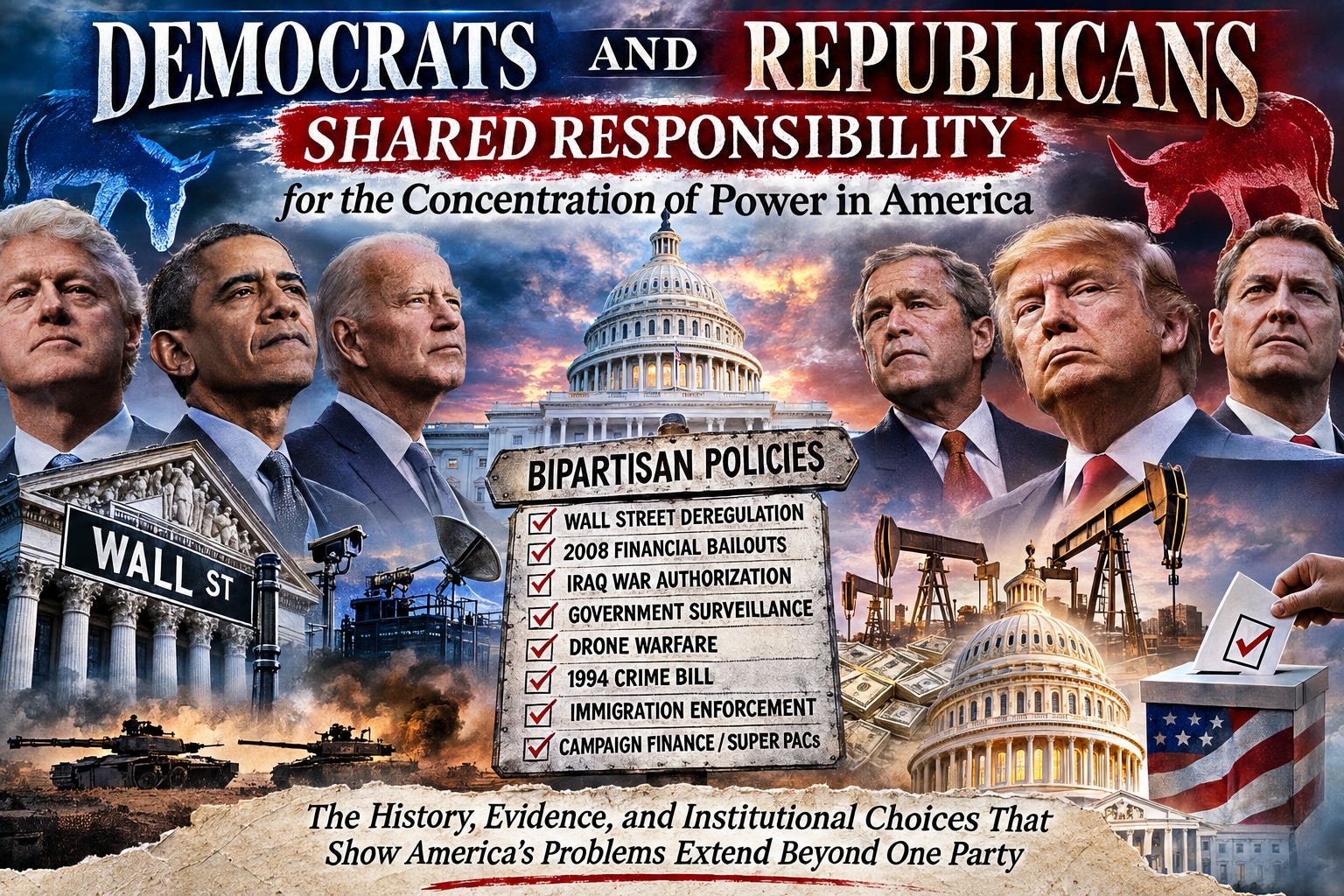
From Wall Street deregulation and the Iraq War to government surveillance, corporate money, and executive power, the historical record reveals a problem that extends beyond Republican and Democratic administrations.
Changing the Party in Power Is Not the Same as Changing the System
The 2026 midterm elections have brought renewed attention to the future of American democracy. With Democrats projected to gain control of Congress, many Americans are asking whether the incoming lawmakers will restore meaningful checks on presidential power and address the institutional problems that have dominated national politics.
But there is another question that deserves equal attention.
What if the Democratic Party helped create and sustain many of the same political and economic conditions it now promises to correct?
This is not an argument that Democrats and Republicans are identical. They are not. Their legislative priorities, political coalitions, and approaches to government differ significantly.
It is an examination of something more fundamental: the historical record of bipartisan participation in policies that expanded financial power, strengthened the national-security establishment, increased government surveillance, and allowed private wealth to exercise enormous influence over American politics.
The evidence suggests that America’s problems cannot be explained solely by the conduct of one political party. Many of the institutions and policies Americans now question were constructed, expanded, or maintained by administrations of both parties.
And that raises a troubling possibility.
Americans may be changing the political leadership without changing the institutional incentives that repeatedly produce the same outcomes.
There is a familiar saying, often mistakenly attributed to Albert Einstein:
“The definition of insanity is doing the same thing over and over again and expecting different results.”
Perhaps this is the paradox of American politics. Every election promises change, yet the underlying structures of concentrated wealth, corporate influence, and political power often remain intact.
If we continue replacing the players without changing the rules of the game, why should we expect a different outcome?
The question is no longer simply which political party governs America, but whether either party is prepared to reform a system from which both have historically benefited. And here is a prediction worth putting to the test:
How many newly elected members of Congress who enter Washington without a million dollars will leave their first term as millionaires?
We do not have to rely on speculation. Members of Congress are required to disclose substantial financial interests, liabilities, and investment transactions. Their financial positions can be examined before taking office and compared with those reported at the end of their terms.
Becoming wealthy is not itself evidence of wrongdoing. But public office should not place anyone beyond financial scrutiny.
And there is a far more important question:
What price did the American people pay, and what compromises were made on their behalf, in exchange for the wealth accumulated by their elected representatives?
Were public policies shaped to serve the broader population or narrow financial interests? Were taxpayers burdened with costs while private interests captured the benefits? Were affordable housing, healthcare, education, and economic opportunities sacrificed in favor of policies that disproportionately benefited those already possessing wealth?
These are questions to investigate, not conclusions to assume. Financial disclosures, legislative voting records, campaign contributions, government contracts, and measurable policy outcomes can help establish whether particular conflicts existed and whether the public suffered identifiable consequences.
The true measure of public service should not be how much wealth a politician accumulates while representing the people, but how much the lives of those people improve during that representation.
If the representatives become wealthier while the people they represent become economically less secure, that disparity deserves investigation. Because ultimately, democracy should not be a mechanism through which political power becomes private wealth at the public’s expense.
Wall Street: When Democrats Helped Dismantle Financial Barriers
In November 1999, Democratic President Bill Clinton signed the Gramm–Leach–Bliley Act. The legislation, championed by Republican lawmakers, removed significant restrictions that had separated commercial banking, investment banking, and insurance activities since the Great Depression. These restrictions had been established partly to prevent conflicts between institutions holding ordinary citizens’ deposits and institutions participating in speculative financial activities.
The 1999 legislation facilitated the consolidation of financial services under large corporate organizations. Supporters argued that modernization would increase competition and improve efficiency. Critics warned that consolidation could increase systemic financial risks and concentrate economic power.
Less than a decade later, the United States experienced the worst financial crisis since the Great Depression.
The 2008 crisis had multiple causes, including risky mortgage lending, excessive leverage, weak regulatory oversight, and failures in financial risk management. It cannot be attributed exclusively to Gramm–Leach–Bliley. Nevertheless, the law remains an important example of bipartisan financial restructuring.
Republicans advanced the legislation. A Democratic president signed it.
The financial system that emerged was not simply a Republican creation.
Source: Federal Reserve History, “Financial Services Modernization Act of 1999.”
The 2008 Financial Crisis: Who Was Protected?
When the financial system approached collapse in 2008, the Republican Bush administration initiated extraordinary government intervention through the Troubled Asset Relief Program. The Democratic Obama administration subsequently oversaw much of the financial stabilization and recovery.
There were legitimate reasons for intervention. The failure of interconnected financial institutions threatened the availability of credit, employment, retirement savings, and the broader economy. But the distribution of the consequences remains a central issue. Large financial institutions received extraordinary government support.
Meanwhile, millions of American households experienced foreclosures, unemployment, lost savings, and declining property values.
The Obama administration subsequently enacted the Dodd–Frank Act, expanding financial oversight and establishing additional consumer protections. That reform matters. It demonstrates that the parties did not respond identically. Yet the crisis also revealed how deeply the government had become dependent on preserving the stability of large financial institutions.
The resulting question was not simply whether banks should have been rescued. It was whether the financial system had become so concentrated that government could no longer allow its largest participants to fail without threatening everyone else.
When private institutions become indispensable to economic stability, their financial risks can become public responsibilities.
That is a structural problem that survives changes in political leadership.
But it raises another fundamental question:
What if the government had allowed failing financial institutions to bear the consequences of their decisions instead of protecting them from collapse?
Would financial institutions have evaluated risk differently if their executives, shareholders, and creditors understood that reckless decisions could result in substantial losses rather than extraordinary government intervention?
Would homeowners have received greater relief if public resources had been directed more aggressively toward mortgage restructuring, principal reductions, and household financial stability?
And would the concentration of wealth have followed a different trajectory if the government had prioritized preserving essential banking services rather than protecting the financial institutions that provided them?
These questions expose a fundamental contradiction in the modern financial system.
Capitalism is generally understood to reward successful risk-taking while imposing losses on those whose investments fail. Yet when financial institutions become so large and interconnected that their collapse threatens the broader economy, governments face enormous pressure to intervene.
This creates what economists call moral hazard: the possibility that institutions will assume greater risks when they expect protection from the consequences.
The 2008 financial crisis demonstrated both sides of this dilemma. Allowing a disorderly collapse could have devastated ordinary Americans through unemployment, frozen credit markets, and additional foreclosures. But protecting major institutions without sufficiently imposing losses on responsible investors and decision-makers also risks weakening market discipline.
The real question was never simply whether the government should rescue the economy. It was whether rescuing the economy required rescuing the financial interests that had helped place it in jeopardy.
An alternative approach would have been to preserve essential financial services while allowing failed institutions to be restructured, shareholders to absorb losses, responsible management to be replaced, and homeowners to receive more effective assistance.
The objective would not have been to punish wealth. It would have been to ensure that financial risk and financial responsibility remained connected. Because when private investors retain the benefits of successful speculation while the public is expected to absorb the consequences of systemic failure, the relationship between capitalism, government, and accountability becomes fundamentally distorted.
If profits remain private while catastrophic losses become a public responsibility, who is actually bearing the risk, and who is receiving the reward?
Campaign Finance: The Contradiction Both Parties Live With
Few issues demonstrate bipartisan institutional dependence more clearly than campaign finance.
The Supreme Court’s 2010 decision in Citizens United v. Federal Election Commission expanded constitutional protections for independent political expenditures by corporations and unions.
Subsequent legal developments helped establish the modern super PAC system.
Today, wealthy individuals and organizations can spend enormous amounts influencing political debate and electoral outcomes through legally independent political committees.
Democrats frequently criticize the influence of billionaires and corporate money.
Republicans frequently defend political spending as protected expression.
Yet both parties benefit from major donors, super PACs, and political organizations capable of financing expensive campaigns. The contradiction is difficult to ignore. A party can criticize concentrated wealth while relying on that wealth to compete electorally.
This does not mean every donation purchases political influence or that every donor expects improper favors. But it creates a system in which wealthy participants possess opportunities for political access and communication unavailable to most citizens.
The constitutional principle of one person, one vote exists alongside enormous inequalities in the financial resources available to influence political outcomes.
The ballot may give citizens equal voting power, but it does not give them equal influence over the political environment in which their choices are made.
The Iraq War: A Bipartisan Authorization With Historic Consequences
In October 2002, Congress voted to authorize military force against Iraq. The George W. Bush administration led the case for war. But the congressional record demonstrates substantial Democratic participation.
In the House of Representatives:
215 Republicans voted in favor.
81 Democrats voted in favor.
126 Democrats voted against.
6 Republicans voted against.
Prominent Democratic senators, including Joe Biden, Hillary Clinton, and John Kerry, also supported the authorization. The subsequent invasion occurred in March 2003.
The alleged Iraqi stockpiles of weapons of mass destruction were not found. The war produced enormous human, financial, and geopolitical consequences. Responsibility was not distributed equally. The Bush administration initiated and directed the war, and most House Democrats opposed its authorization. Nevertheless, Democratic support was an important part of the congressional authorization.
This history matters whenever lawmakers criticize presidential military intervention.
The relevant question is not simply whether politicians oppose a particular war. It is whether they support consistent limits on executive military authority when a president from their own party occupies the White House.
Source: U.S. House of Representatives, Roll Call 455, October 10, 2002.
The Surveillance State: Expanded Under Republicans, Maintained Under Democrats
Following the September 11 attacks, Congress passed the USA PATRIOT Act. The legislation expanded federal investigative and surveillance authorities. It passed the Senate by an overwhelming bipartisan vote of 98–1.
During the Obama administration, disclosures in 2013 revealed that the National Security Agency had conducted bulk collection of telephone metadata under an interpretation of Section 215 of the PATRIOT Act. The disclosures triggered major debates about privacy, constitutional protections, government secrecy, and national-security oversight. Subsequent reforms restricted certain surveillance practices. But the larger institutional pattern remains significant.
Republican and Democratic administrations both exercised extensive national-security powers. The question is not whether government should possess lawful tools to investigate threats. It is whether citizens and their elected representatives can meaningfully supervise powers exercised largely outside public view.
A surveillance authority considered dangerous under one president does not automatically become harmless when another party takes office.
Drone Warfare: Executive Military Power Under Obama
President Barack Obama expanded the use of armed drones for counterterrorism operations outside conventional battlefields. According to estimates discussed by the Council on Foreign Relations, approximately 542 strikes occurred in Pakistan, Yemen, and Somalia during his presidency, resulting in thousands of deaths, including an estimated number of civilian casualties.
The administration argued that targeted strikes could address security threats while avoiding larger military deployments. Critics questioned civilian casualties, transparency, the legal basis for targeting, and the degree of congressional oversight.
This controversy illustrates a recurring institutional issue. Presidents inherit military and national-security authorities established by previous administrations. Rather than consistently reducing those powers, successive administrations may preserve or expand them. The resulting concentration of executive authority can become a concern regardless of which party controls the presidency.
The 1994 Crime Bill: Bipartisan Policies and Mass Incarceration
President Bill Clinton signed the Violent Crime Control and Law Enforcement Act in 1994. The legislation expanded federal criminal-justice programs, funded policing initiatives, encouraged prison construction, and included sentencing provisions.
It received bipartisan support. Although incarceration had been increasing before the legislation, aspects of the law contributed to the broader punitive criminal-justice environment of the period.
Over time, policymakers and researchers raised concerns about excessive incarceration, racial disparities, sentencing practices, and the social consequences of long prison terms. Some Democratic lawmakers subsequently supported criminal-justice reforms. But the historical record demonstrates that policies now criticized for their consequences were not simply imposed by Republicans. They were also advanced and signed by Democratic leaders.
Immigration Enforcement Did Not Begin With Trump
Immigration enforcement has become one of the most politically divisive issues in America. The Trump administration’s enforcement policies have generated substantial controversy over detention, deportation, due process, and the use of federal authority. But extensive immigration enforcement predates Trump.
During the Obama administration, the United States conducted millions of formal removals. The administrations differed in enforcement priorities, legal practices, treatment of families, and approaches to humanitarian protection.
Those differences matter.
Nevertheless, the broader enforcement infrastructure existed across multiple presidencies. This illustrates why institutional accountability cannot depend exclusively on political affiliation. If detention practices, due-process protections, and government enforcement powers raise constitutional concerns, those concerns deserve consistent examination regardless of the president.
Foreign Policy: Continuity Across Administrations
American foreign policy often displays greater continuity than domestic political rhetoric suggests. Military alliances, weapons sales, foreign assistance, intelligence cooperation, and strategic commitments frequently continue across administrations.
The Biden administration maintained substantial military assistance to Israel during the Gaza war while also criticizing aspects of Israeli military operations and restricting certain weapons transfers. Democratic lawmakers themselves disagreed over the appropriate conditions for assistance.
The broader question concerns who determines American foreign-policy priorities and how Congress evaluates the humanitarian, economic, and security consequences of military commitments. This becomes especially important when international conflicts influence domestic energy prices, financial markets, inflation, and public spending.
Foreign policy is not separate from the American economy. It is deeply connected to it.
From Government Decisions to Financial-Market Influence
This brings us to one of the most important transformations in modern governance.
Historically, financial markets were often understood as reacting to government decisions. Governments established policies. Markets adjusted prices in response.
Today, the relationship is more visibly reciprocal. Government decisions influence financial markets, while financial-market reactions can constrain government decisions.
Consider oil markets. Military escalation in the Middle East can increase expectations of petroleum supply disruption. Those expectations can raise oil prices, even before physical shortages occur. Diplomatic developments can reduce the perceived risk, potentially lowering prices.
Financial participants who correctly anticipate these movements may profit. But the mechanism also creates opportunities for conflicts of interest if government officials or connected individuals possess advance knowledge of market-moving decisions. Such possibilities warrant safeguards and investigation when supported by evidence. They do not establish that a particular official deliberately manipulated markets.
The structural concern is larger.
When government policy moves financial markets and financial markets influence government policy, economic power and political authority become increasingly interdependent.
This is where the debate over oligarchy becomes relevant.
Oligarchy Is Not Merely About Wealth
Oligarchy is generally understood as a political system in which a relatively small group exercises disproportionate power. Wealth alone does not establish oligarchic control. The more important question is whether concentrated economic resources translate into privileged political access, favorable government decisions, or reduced accountability.
In modern America, several institutions deserve examination:
Corporate lobbying.
Campaign financing.
Government contracting.
Financial regulation.
Military procurement.
Technology infrastructure.
Political appointments.
The relationships between these institutions do not prove that government is controlled by a coordinated group of wealthy individuals. But they reveal channels through which private economic interests can influence public decisions. And these channels do not disappear when voters replace Republicans with Democrats.
The Danger of False Equivalence
A credible historical assessment must also acknowledge where the parties differ.
The Democratic-controlled Congress enacted Dodd–Frank financial reforms. Most House Democrats opposed the Iraq War authorization.
Democratic and Republican administrations have pursued different healthcare, labor, environmental, and taxation policies.
Likewise, the efforts to overturn the 2020 presidential election and the January 6 attack cannot simply be assigned equal responsibility across both parties because they participated in other controversial policies.
Shared responsibility for some institutional problems does not mean equal responsibility for every event. This distinction is essential.
The objective should not be to manufacture equivalence between political parties. It should be to establish accountability using consistent evidence and standards.
The Real Test of the New Democratic Congress
The 2026 midterm results create an opportunity for renewed congressional oversight. But investigations alone will not resolve structural problems that have developed over decades. The more meaningful test will be whether Congress supports safeguards that constrain future administrations of both parties.
That includes stronger financial-conflict disclosures, enforceable restrictions on congressional stock trading, transparent political financing, independent government auditing, meaningful oversight of military operations, and clearly defined limits on executive authority.
The same standards should apply to Democratic and Republican officials. A reform that restrains only political opponents is not a durable institutional safeguard. And a congressional investigation that ignores similar conduct by political allies risks weakening public confidence in oversight itself.
Conclusion: Two Political Parties, One Continuing Class War
The Democratic victory in the 2026 midterms may change the balance of power in Washington. But it will not automatically change the economic and political structures that have developed over generations.
The historical record demonstrates that administrations and lawmakers from both major parties have participated in consequential decisions involving financial deregulation, corporate bailouts, military intervention, surveillance, criminal justice, immigration enforcement, and campaign finance.
Their individual responsibilities differ, but the institutional consequences are undeniable.
Financial institutions retain enormous economic influence. Wealthy donors remain central to political campaigns. Large corporations continue seeking government contracts, regulatory advantages, subsidies, and preferential access to policymakers. Presidents inherit extensive executive authority, while ordinary Americans continue struggling with housing costs, healthcare expenses, consumer debt, and economic insecurity.
Whether knowingly or unknowingly, both political parties have participated in policies that critics of economic inequality characterize as class warfare: a continuing struggle over who controls wealth, who receives its benefits, and who bears the costs of economic and political decisions.
Not every politician enters public service with selfish intentions. Many undoubtedly seek office because they believe they can improve people’s lives, defend constitutional principles, or correct injustices. But political ambition eventually encounters the financial machinery of American politics.
Campaigns require money.
Political careers require fundraising.
Access to influential donors becomes valuable.
Corporate relationships create opportunities.
Investments can generate personal wealth.
And maintaining political power can become increasingly dependent on the very economic interests elected officials were supposed to regulate.
Some politicians resist these pressures. Others accommodate them. Still others may come to regard the interests of wealthy supporters as inseparable from the interests of the nation itself.
The danger is that public servants can gradually become participants in a system of concentrated economic power, even when they originally entered politics intending to challenge it.
And that brings us to the uncomfortable question at the heart of American democracy:
What price have the American people paid, and what compromises have been made on their behalf, while their elected representatives and politically connected interests accumulated wealth?
This question demands investigation rather than assumptions of individual guilt. Financial disclosures, campaign contributions, legislative decisions, government contracts, and measurable economic outcomes provide a starting point for determining whether particular officials benefited from decisions that imposed costs on the public.
The broader issue is not whether every wealthy politician is corrupt. Wealth alone proves no wrongdoing.
The issue is whether the political system provides sufficient safeguards against the conversion of public authority into private financial advantage.
When financial institutions receive extraordinary protection while households face foreclosure, when corporations benefit from favorable legislation while workers struggle to maintain purchasing power, and when public resources support private financial interests without adequate accountability, the resulting distribution of benefits and burdens deserves scrutiny.
These outcomes are central to the argument that class conflict persists regardless of which party controls Washington.
Republicans and Democrats may disagree about how government should operate, but both have helped maintain institutions through which economic power can become political influence, and political influence can help preserve economic power.
This does not establish that every politician deliberately wages class warfare. Nor does it mean both parties have identical records. It means that participation in a system can perpetuate its consequences even without a coordinated intention to do so.
The Founders established a constitutional system intended to prevent the concentration of unchecked political authority.
Today, that challenge extends beyond government itself. It includes the relationship between elected officials, financial institutions, multinational corporations, wealthy donors, and emerging technologies capable of concentrating unprecedented economic and informational power.
The fundamental question is whether democratic institutions can remain independent when the financial resources required to obtain and retain political office are so unevenly distributed. And whether those institutions can serve the economic interests of the broader population while remaining deeply connected to concentrated private wealth.
Changing the party in office does not necessarily eliminate these incentives.
Americans may replace the politicians, but unless the rules governing political money, financial conflicts, corporate influence, and public accountability change, the underlying struggle over economic power can continue.
The answer cannot come from partisan loyalty alone.
It requires transparency, independent evidence, enforceable limits on government authority, meaningful financial accountability, and institutions willing to investigate misconduct regardless of political affiliation.
It also requires examining political success through a different measure: not simply whether the economy grows or financial markets rise, but whether ordinary Americans share in that prosperity, gain economic security, and retain meaningful control over their lives. Because the purpose of representative government is not to create opportunities for representatives to enrich themselves at the expense of those they represent. It is to protect the rights, interests, and opportunities of the people who entrusted them with power.
Democracy is not secured merely by replacing the people in power. It is secured by ensuring that power itself remains accountable, and that the prosperity generated by society does not come at the expense of the people who sustain it.
And until that accountability becomes a permanent feature of American government, rather than a promise made during election campaigns, the debate over class warfare will continue regardless of whether Democrats or Republicans occupy the halls of power.

Editorial note: This article distinguishes documented government actions from broader interpretations of their institutional consequences. Historical participation in a policy does not automatically establish unlawful conduct, corrupt intent, or equal responsibility among political parties. The 2026 election references reflect the reported post-election situation rather than final certified results.