

1. Introduction: The Billion-Dollar Breaking Point
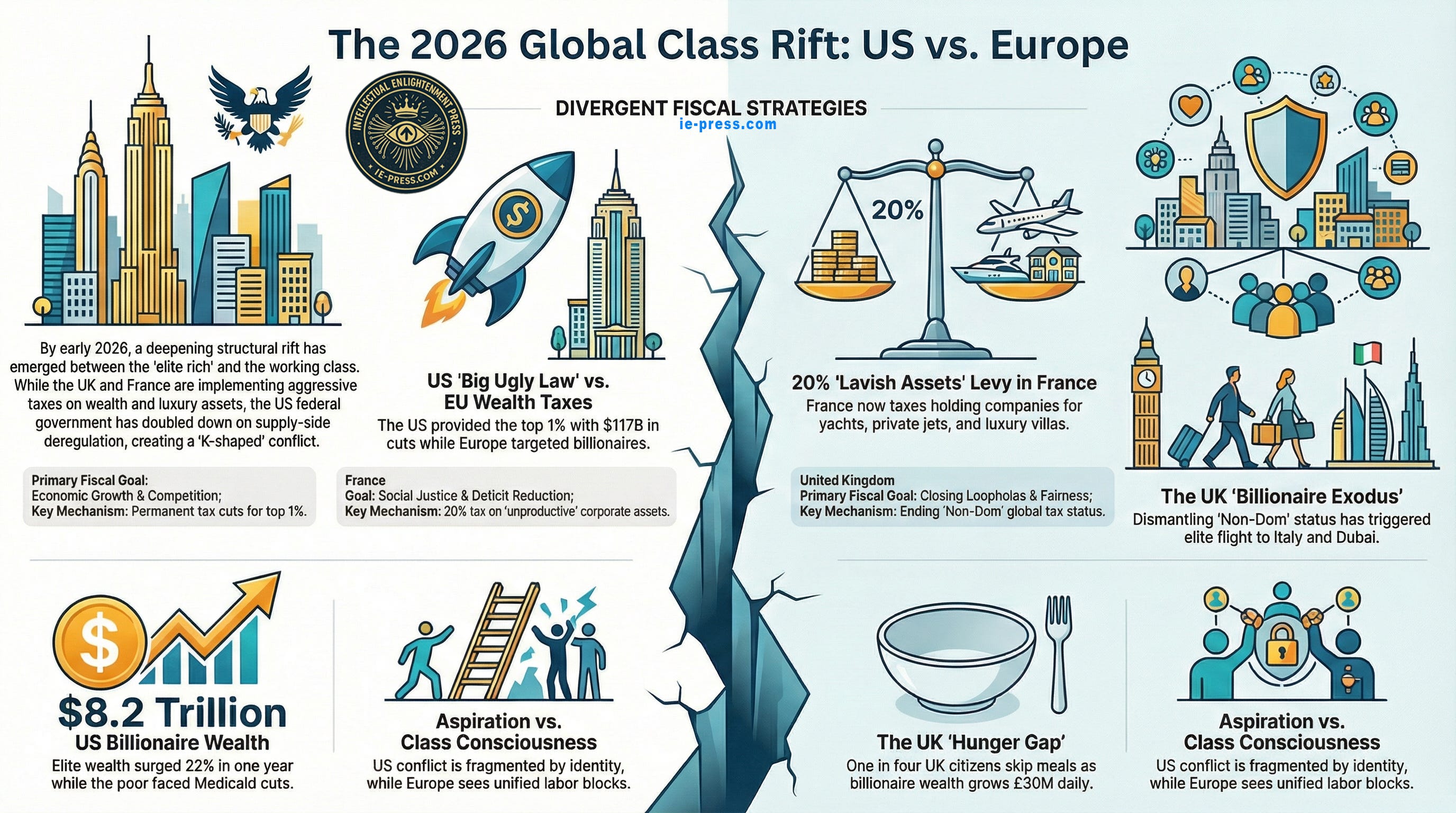
As we cross the threshold of early 2026, the global economy has fractured into two irreconcilable financial realities. In the United States, a “K-shaped” conflict has reached its zenith, with billionaire wealth hitting stratospheric records while the working class navigates a “double squeeze” of high tariffs and evaporating social safety nets.
Across the Atlantic, Europe remains mired in a “permacrisis,” attempting to patch a crumbling social contract through aggressive austerity and targeted levies on the ultra-wealthy. This is no longer a mere policy debate; it is a high-stakes struggle for survival and status. The following analysis explores the structural rifts defining this new era of global class tension.
2. The “Big Ugly” Paradox: How the U.S. Became a Global Tax Haven
The primary catalyst for American class friction is the 2025 Tax and Spending Megabill, derisively nicknamed the “Big Ugly Law.” Formally titled the One Big Beautiful Bill Act (OBBBA), this legislation made the 2017 tax cuts permanent, effectively codifying the United States as the world’s premier tax haven for the ultra-rich.
The OBBBA provided the top 1% with an aggregate $117 billion in tax cuts in 2026 alone, with the average billionaire seeing a net cut of roughly 66,000. While billionaire wealth surged 22% to a record **8.2 trillion**, the bottom 20% of earners have faced a net loss in resources. Federal rhetoric frames these cuts as “American growth” designed to lure billionaires fleeing new tax regimes in Paris and London.
However, the working class pays the entry fee for this tax haven. Minor tax breaks on tips have been swallowed by broad tariffs on imports, which act as a regressive consumption tax, raising the cost of everyday goods at retailers like Walmart by 15–20%. Simultaneously, deep cuts to SNAP and Medicaid have turned the “daily cost of survival” into a desperate calculation.
“We are operating in two financial realities: record corporate profits and soaring stock values for the wealthy, alongside deepening hardship for millions of ordinary households.” — 2026 Economic Analysis, The Fulcrum.
3. Fragmented by Design: Why Americans Aren’t Storming the Barricades
Despite record inequality, the U.S. remains an outlier in class mobilization. The American conflict is “fragmented by design,” maintained by structural and cultural stabilizers that prevent the unified “street war” seen in France. Foremost is the “Golden Handcuff” effect: because healthcare and welfare are tied to employment, striking carries the existential risk of losing access to medicine.
This system allows corporate leaders to function as a private welfare state, deciding the quality of life for their workers on an individual basis. Furthermore, racial identity acts as a “class buffer,” with cultural conflicts frequently diverting economic solidarity. Many workers prioritize racial or cultural status over class unity, viewing the “elite” as either “billionaire exploiters” or “woke coastal liberals.”
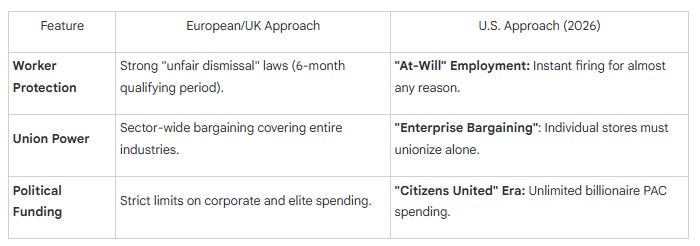
The persistent “Meritocracy Myth” also acts as a pressure valve. Many American workers view themselves as “entrepreneurs-in-waiting” or “temporarily embarrassed millionaires” rather than a permanent working class. This individualist ethos encourages private “side hustles” over collective strikes, as summarized in the legal architecture below:
4. The Luxury Lockdown: France’s War on “Lavish Assets”
France is currently gripped by a state of “political exhaustion” following the passage of the 2026 Austerity Budget. Prime Minister Sébastien Lecornu utilized Article 49.3 to force through €43–46 billion in public spending cuts, a move that bypassed the National Assembly and sparked widespread cries of a “democratic deficit.”
To maintain social peace, the government secured “social scalps” for the working class, including a suspension of pension reforms and the implementation of €1 student meals. The cornerstone of this compromise is a new “Holding Company Tax,” a 20% levy on “unproductive” assets like luxury yachts, private jets, and racehorses held within corporate structures.
However, the elite have already begun circumventing these measures through “re-labeling.” High-priced lawyers are currently flooding courts to argue that private jets and luxury villas are “essential business operations,” turning the levy into a perceived “slap on the wrist.” With the total rejection of the “Zucman Tax” (a flat 2% tax on billionaires), many feel the true elite remains protected.
“The French way of seeing things now is that if you are successful, if you are rich... then you are a thief.” — Éric Larchevêque, Entrepreneur.
5. The “Non-Dom” Exodus and the Stagnation Trap in England
In England, the “slow-motion fracturing” of society has accelerated with the end of the “Non-Dom” era. The new 4-year Foreign Income and Gains (FIG) regime has triggered a “billionaire exodus” to tax-neutral hubs like Dubai or Italy. This flight is particularly stinging given that the richest 50 families in the UK now hold more wealth than the bottom half of the population combined.
The result is a “Stagnation Trap” where the working class faces a widening “hunger gap” and “hygiene poverty.” Over a million children currently lack basics like toothpaste or soap, while one in four citizens reports regularly skipping meals due to costs. This “shame of the breadline” has turned public sentiment sharply against an elite that has largely opted out of public life.
While the average citizen navigates a crumbling infrastructure and bankrupt local councils, the wealthy use private healthcare and education that hit a five-year high in 2025. This allows the elite to remain insulated, making public service cuts invisible to the very people who influence policy.
“Nothing’s changed? Everything’s changed. It’s worse.” — 2026 UK Poverty Report, Joseph Rowntree Foundation.
6. The New Militancy: Grassroots Strikes and the Death of the “American Dream”
The old stabilizers of the American Dream are finally buckling. Gen Z and Alpha have emerged as the most pro-union generation in 80 years, explicitly rejecting the traditional meritocracy narrative. Early 2026 has been defined by a wave of militant strikes that bypass traditional union leadership to target the “billionaire bosses” directly.
San Francisco Teachers: Striking against tech-billionaire spending that has rendered civil servant housing impossible.
Kaiser Permanente: Over 30,000 nurses and lab workers protesting profit-driven service cuts.
Starbucks Workers United: Expanding strikes to 130 cities, framing the fight as an existential class war.
This unrest is accompanied by a massive political realignment. In the UK, young progressives have gravitated toward “Your Party,” a radical wealth-redistribution movement. In the U.S., a multi-racial shift is occurring; Black and Latino working-class men are moving toward the GOP, driven by a “hustle culture” ethos and frustration with status-quo results. Meanwhile, a “believability gap” has widened, as 19 million low-income voters stayed home in the last cycle, convinced that neither party will make rent or groceries affordable.
7. Conclusion: A Future of Fractures or Foundations?
The 2026 realignment has drawn a stark line between two competing visions of the future. The United States has doubled down on a “tax the rich less” strategy to win the global competition for billionaire capital, while Europe is attempting to “tax the lifestyle” of the elite to preserve a tenuous social peace.
As billionaire wealth hits the $8 trillion mark in the U.S. and “hygiene poverty” becomes a staple of English life, we are forced to confront the ultimate structural question. Can the “American Dream” survive a cavernous $8 trillion wealth gap, or is the “slow-motion fracturing” currently seen in England the inevitable destination for all advanced economies?
Solid article and I hear what you are saying. Though we do have be careful. Now, I can't disagree with your facts because their correct.
We do need to slow ourselves down as we can slide from healthy skepticism into generalized nihilism. If “everyone is lying, it’s all information war, nothing is real", is sound, but dangerous. Once we cross that line, we are extremely vulnerable to whoever offers the most emotionally resonant story, not the truest one.
Furthermore, if we can get stuck in a doom‑loop. If every new data point is interpreted as confirmation that collapse is inevitable, elites are in total control, and our only options are rage, withdrawal, or maximalist politics. That’s corrosive to agency.
This does play into information and cognitive warfare as we cannot make a decision due to insane amount of friction generated. How we deal with it? Well, I'm still trying to figure that out.