

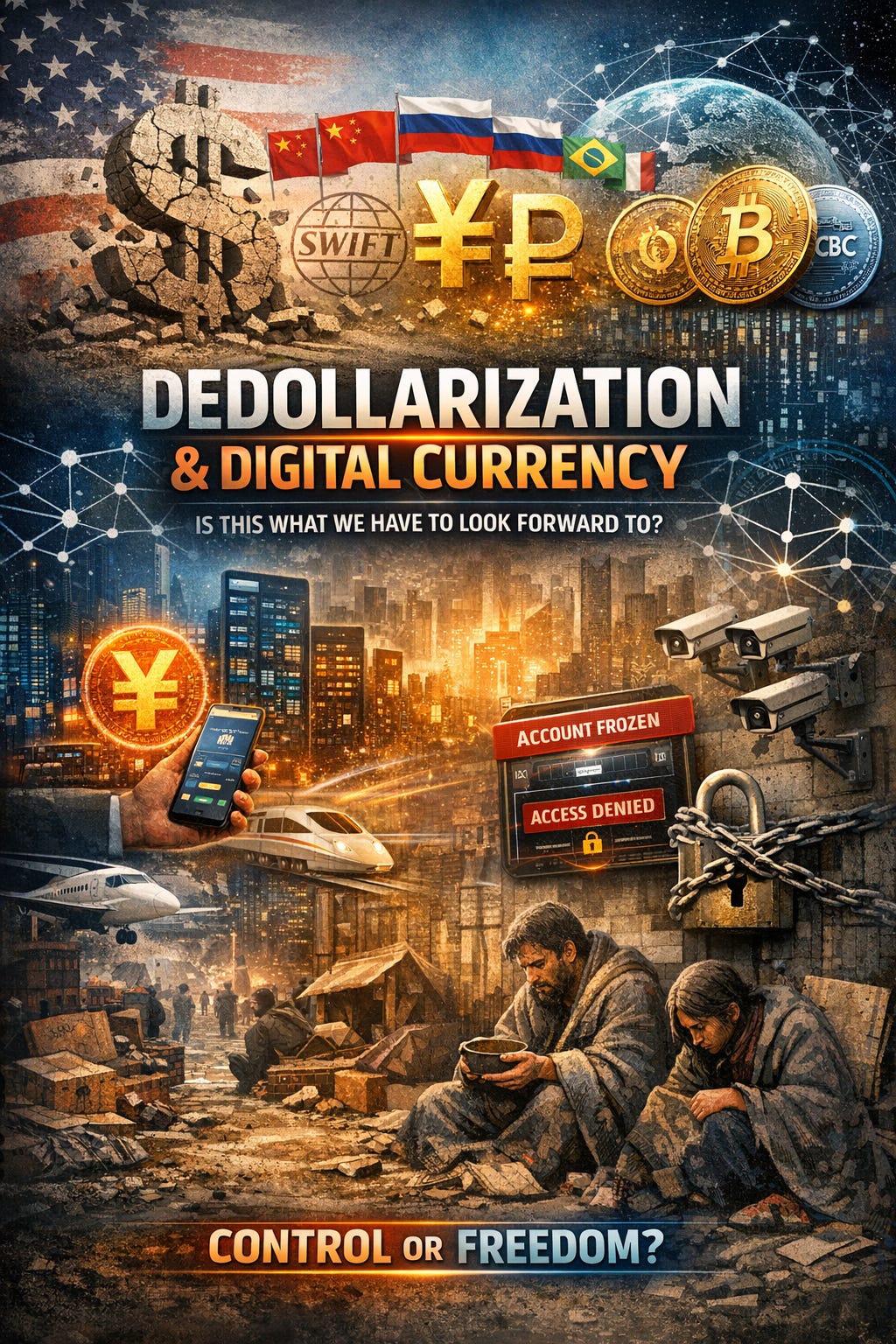
For nearly a century, the global economy has revolved around one central pillar: the U.S. dollar. From oil trades to international debt, the dollar has functioned as the world’s primary reserve currency, giving the United States enormous economic and geopolitical power.
But that system is beginning to shift.
A growing movement known as dedollarization, combined with the rapid rise of digital currencies—is reshaping how money works globally. The question isn’t whether change is coming. It’s how deep it will go—and what it means for everyday people.
What Is Dedollarization?
Dedollarization is the process of countries reducing their dependence on the U.S. dollar for:
International trade
Foreign reserves
Energy transactions
Financial settlements
Instead of using dollars, nations are increasingly trading in:
Their local currencies
Alternatives like the Chinese yuan
Commodity-backed agreements (oil, gold, etc.)
This shift is being led by countries like China, Russia, India, and blocs such as BRICS.
Why is this happening?
Geopolitical leverage
The U.S. has used dollar dominance (via sanctions and financial systems like SWIFT) as a strategic weapon.Debt concerns
The U.S. national debt and monetary expansion raise long-term confidence questions.Multipolar world shift
Power is no longer concentrated in one region, economic influence is spreading.
The Digital Currency Layer
At the same time, a second transformation is happening: money itself is going digital.
There are three main types:
1. Central Bank Digital Currencies (CBDCs)
Government-issued digital money, controlled by central banks.
Examples:
Digital yuan (China)
Digital euro (in development)
U.S. digital dollar (under discussion)
2. Cryptocurrencies
Decentralized, borderless digital assets like Bitcoin and Ethereum.
3. Stablecoins
Digital tokens pegged to fiat currencies (like the dollar), blending traditional finance with blockchain tech.
Where Dedollarization Meets Digital Currency
This is where things get interesting, and potentially disruptive.
Countries aren’t just moving away from the dollar…
They’re building new financial rails entirely.
Instead of:
USD → U.S. banks → SWIFT → global settlement
We’re seeing:
Local currency → digital platform → direct settlement
This removes:
Dollar dependency
U.S. oversight
Traditional banking intermediaries
The China Example: Control Through Digital Systems
Your uploaded material highlights a critical concept, what happens when financial systems become fully digital and centralized.
In China, systems like digital payments and blacklists can effectively restrict economic participation. For example:
Individuals can be blocked from renting housing
Employment opportunities limited
Digital wallets restricted
Travel access denied
This creates what some analysts describe as a “digital financial lockout”, where access to money determines access to life itself.
As noted in your material:
Financial restrictions can make it “nearly impossible to buy food, pay for transport, or receive a salary”
That’s not theoretical, that’s already happening in localized forms.
What This Means for the Future
1. Less Global Unity, More Fragmentation
Instead of one dominant currency system, we may see:
Competing currency blocs
Regional financial ecosystems
Parallel payment systems
2. Faster, Cheaper Transactions
Digital currencies can:
Eliminate intermediaries
Enable instant cross-border payments
Reduce transaction costs
3. Increased Surveillance & Control
This is the tradeoff most people don’t fully grasp.
With digital currency, governments (or platforms) could:
Track every transaction
Set spending rules
Freeze accounts instantly
Enforce behavior through financial access
Is This What We Have to Look Forward To?
Not necessarily, but it’s one possible trajectory.
There are two competing futures emerging:
Path 1: Centralized Digital Control
Governments control digital money
Financial access tied to compliance
High efficiency, low privacy
Path 2: Decentralized Financial Sovereignty
Individuals control assets (crypto, self-custody)
Less reliance on governments
More freedom, but more personal responsibility
The Real Shift: Power Over Money
This isn’t just about currency, it’s about who controls value.
For decades:
Governments controlled money.
Now:
Technology is challenging that control.
The outcome will depend on:
Policy decisions
Adoption of decentralized tools
Public awareness
Bottom Line
Dedollarization and digital currency aren’t separate trends, they’re converging into a new financial architecture.
The dollar’s dominance is weakening (slowly, not collapsing overnight)
Digital systems are replacing traditional banking rails
Control vs freedom is becoming the central tension
What we’re moving into is not just a new currency system, but a new economic operating system for the world.