

The escalation of hostilities in the Persian Gulf during the first quarter of 2026 marks a watershed moment in the history of transatlantic relations, signaling the potential dissolution of the “Special Relationship” that has underpinned Western security for over eight decades. On Saturday, March 7, 2026, a social media communication from President Donald Trump initiated a profound recalculation among the financial and political elite in the City of London. While mainstream American media outlets characterized the President’s remarks as a standard diplomatic rebuff of British Prime Minister Keir Starmer, a deeper analysis reveals a sophisticated critique of the structural dependencies inherent in the global financial system. The declaration that the United Kingdom, described as a “once Great Ally”, is no longer “needed” for American military objectives serves as a formal notice that the era of joint US-UK imperial ventures has reached its conclusion.
The Strategic Rupture: Truth Social as a Geopolitical Instrument
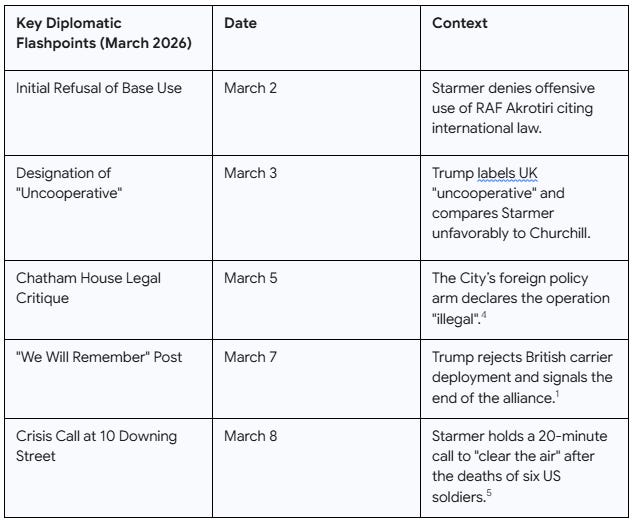
The friction between Washington and London reached a critical juncture following the US-Israeli military intervention in Iran, a campaign codified as “Operation Epic Fury”. The core of the dispute originated from the British government’s initial refusal to permit the use of sovereign bases, such as RAF Akrotiri in Cyprus and the Diego Garcia facility, for offensive strikes against Iranian missile and nuclear infrastructure. Prime Minister Keir Starmer defended this hesitation by emphasizing the necessity of a “lawful basis” and a “viable and thought-through plan”. However, this legalistic posture was interpreted by the Trump administration as a calculated abandonment by a historic partner at a moment of high-intensity conflict.
The Message to the City of London
The President’s assertion that the US “will remember” the UK’s delay in support transcends mere personal animosity toward Starmer. It is increasingly viewed as a direct message to the City of London, the financial heart of the British state, which has historically exercised control over global commodities through the mechanisms of insurance, contract law, and maritime regulation. The “battlefield” is not merely the sands of the Middle East, but the pricing mechanisms of the global economy. By rejecting the late-stage British offer to deploy the aircraft carrier HMS Prince of Wales, the Trump administration signaled that it has decoupled its security objectives from the requirements of the London-centered financial order.
Historical Precedents: The End of the “War Drag”
A persistent theme in the current administration’s critique is the historical pattern of British influence on American foreign policy. Critics of the legacy “Special Relationship” argue that the United Kingdom has effectively “dragged” the United States into every major conflict since World War I to preserve the structural integrity of the British financial empire. The current crisis in Iran represents the first major conflict in a century where Britain has sought to “sit out” the initial phase, a move interpreted not as a sudden surge of moral conscience, but as a strategic protection of the City of London’s business interests.
The legacy of the 2003 Iraq War looms large over this decision. The “Iraq debacle” remains a primary driver of the Starmer government’s caution. However, the Trump administration views this caution as a selective application of international law designed to hamper American “Energy Dominance”.
The City of London Business Model: The “Toll Collector” Paradigm
To understand the current tension, it is necessary to examine the historical evolution of the City of London. The City does not generate wealth primarily through the production of raw materials; rather, it controls the “choke points” of the global economy through information and financial gatekeeping.
From Coffee House to Global Hegemony
The foundation of this power dates back to 1688, when Edward Lloyd opened a coffee house in London that served as a marketplace for ship captains and merchants to “gamble” on vessel safety. For 150 years, the British government protected this model by making it illegal for other insurance companies to compete with Lloyd’s, allowing the market to build an information monopoly through Lloyd’s List, a newspaper that tracked every ship on Earth. By the time competition was permitted in 1824, the City had already established itself as the global “toll collector,” controlling the contracts, futures markets, and insurance for critical raw materials like oil, lithium, and copper.
The Institutional Shift: Wall Street at the Helm
In the modern era, the City has evolved from a collection of aristocratic “Names” into a marketplace for global institutional capital. Asset managers such as Blackstone and BlackRock have pumped billions into Lloyd’s syndicates through structures like London Bridge 2, a risk transformation platform. Blackstone, for example, has provided dedicated three-year capacity to syndicates like Syndicate 2126, essentially integrating Wall Street yield-seeking with London’s regulatory and legal leverage.
The Insurance Blockade: The Closure of the Strait of Hormuz
A central revelation of the 2026 conflict is that the Strait of Hormuz was not closed by Iranian missiles alone, but by a “spreadsheet and a signature” in London. On March 5, 2026, Lloyd’s of London and the International Group of P&I Clubs, 13 private, London-based associations that insure 90% of all ocean-going ships, cancelled war risk coverage for the entire Persian Gulf.
The Mathematics of Maritime Stagnation
Without insurance, commercial shipping is functionally suicide. The financial exposure for a single transit is insurmountable:
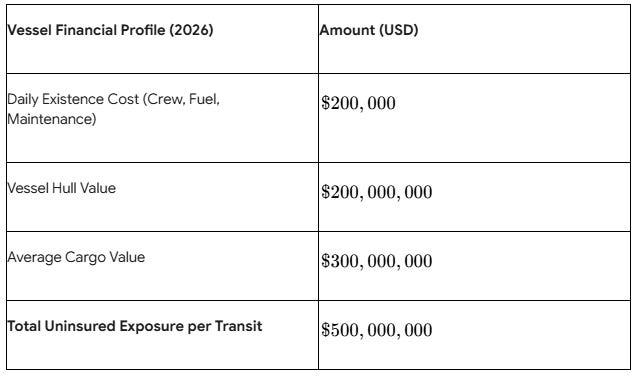
International maritime law and banking requirements dictate that a vessel cannot sail without insurance; the bank owning the ship’s mortgage, the port of entry, and the charterers all require it. By canceling coverage for everyone, without asking Washington or the UN, these private clubs effectively overrode the diplomatic strategies of sovereign nations.
The “Oil Price Hoax” vs. The Supply Reality
Despite the hysteria regarding “spiking” energy prices, the US Department of Energy maintains that the world remains well-supplied. Energy Secretary Chris Wright has explicitly stated that the current price increases. reaching a national average of $3.45 per gallon, are the result of “emotional reactions and fear” rather than a physical supply shortage.
The Fear Premium
Secretary Wright’s analysis suggests that the market is reacting to a “fear premium” engineered by the withdrawal of insurance. The relationship between perceived risk and actual premium can be expressed by the following formula:


Iran’s “Diplomatic Gate” and its Failure
A critical aspect of the March 2026 crisis was Iran’s attempt to bypass the blockade through a conditional transit strategy. The IRGC announced a “diplomatic gate,” offering transit to any nation that expelled American and Israeli diplomats. While Iran waved through two vessels to prove the concept, the move was neutralized by London. Even if a captain wanted to accept the Iranian “red carpet,” the cancellation of war risk coverage meant the ships were legally unable to leave port. This proved that real power over the strait was held not by military might, but by the underwriters in London.
The Eschatological Dimension: Hegemonic Succession and the Monetary Reset
A distinct dimension of analysis, prevalent in regional eschatological frameworks, views the 2026 conflict as a deliberate catalyst for a global transition of power. This perspective posits that the “Special Relationship” is not merely fraying but is being systematically replaced as the global order moves through defined stages of hegemony.
The Succession of Ruling States
According to this framework, global history is defined by a sequence of “ruling states.” The era of British hegemony (the “first day”) was followed by the American era (the “second day”). The 2026 conflict is interpreted as the transition to a third and final stage, where a new power, centered in the Middle East, replaces the United States. This transition requires the dismantling of the existing monetary system, specifically the collapse of the Bretton Woods accord and the disappearance of the US dollar as the global reserve currency.
The Elimination of “Nuclear Obstacles”
A primary strategic objective identified in this narrative is the elimination of the only sovereign obstacles to this new hegemony: Iran’s missile capacity and Pakistan’s nuclear weapons. Operation Epic Fury is thus viewed not as a standard counter-proliferation strike, but as a prerequisite for a “Big War” intended to expand territorial control to “Biblical frontiers”, specifically from the “River of Egypt to the River Euphrates”. In this view, the “climax of terrorism” and the manufactured energy panics are stages in a larger “Dajjal” (Antichrist) system designed to consolidate global control through financial and military crises.
U.S. Response: De-Monopolizing Maritime Insurance
To break the “actuarial blockade” and counter these manufactured crises, the Trump administration has positioned the United States as a state-backed insurer, effectively sidelining the City of London.
The DFC Sovereign Reinsurance Plan
President Trump directed the U.S. International Development Finance Corp (DFC) to provide political risk insurance and guarantees for maritime trade at “reasonable prices”. This includes a $20 billion commitment to support marine reinsurance, which allows global shipping firms to bypass the London-based private market.
Sidelining the UK
By acting as both the primary naval escort and the primary insurer, the U.S. asserts total control over the strait at two levels: physical security and financial coverage. This strategy effectively:
Redirects Premiums: Billions in insurance premiums that once flowed to London are now redirected to U.S. state coffers.
Removes Financial Leverage: Private London underwriters can no longer “close” the strait by refusing signatures on a spreadsheet.
Ensures Sovereign Flow: Energy shipments can continue based on U.S. policy rather than the “regulatory compliance” narratives used by the City to justify blockades.
Conclusion: The New Sovereign Reality
The Iranian conflict of 2026 has served as the catalyst for a grand realignment in global power. It has exposed the City of London as a strategic actor that uses financial instruments, specifically maritime insurance, to override the strategies of sovereign nations. Whether viewed as a purely financial power struggle or as a stage in an eschatological succession of “ruling states,” the outcome is the same: the formal end of the post-1945 “Special Relationship.”
The phrase “we will remember” is a formal notice: the era of the empire is over, and the era of the sovereign nation has begun. The 2026 crisis has proven that the real “Strait of Hormuz” is not just a geographic chokepoint, but a financial and historical one, a chokepoint the United States has now chosen to bypass permanently in favor of a new, sovereign paradigm.
Works cited
‘We don’t need people that join wars after we’ve already won’: Trump …, accessed March 11, 2026, https://indianexpress.com/article/world/us-news/trump-starmer-uk-aircraft-carriers-middle-east-iran-war-10570577/
Trump tells Starmer help not needed even as US uses UK bases for Iran strikes, accessed March 11, 2026, https://www.theguardian.com/us-news/2026/mar/07/trump-starmer-iran-criticism
Operation Epic Fury: Reports of the Death of International Law are Greatly Exaggerated, accessed March 11, 2026, https://www.justsecurity.org/133579/operation-epic-fury-international-law/
UK arguments for US operations from its bases blur the line between lawful self-defence and unlawful war on Iran, accessed March 11, 2026, https://www.almendron.com/tribuna/uk-arguments-for-us-operations-from-its-bases-blur-the-line-between-lawful-self-defence-and-unlawful-war-on-iran/
Starmer speaks to Trump after criticism of U.K.’s response to Iran strikes — The Hindu, accessed March 11, 2026, https://www.thehindu.com/news/international/starmer-speaks-to-trump-after-criticism-of-uks-response-to-iran-strikes/article70723081.ece
‘That’s ok, don’t need them any longer’: Trump rebukes Starmer after UK mulls carriers to Iran, accessed March 11, 2026, https://www.hindustantimes.com/india-news/thats-ok-dont-need-donald-trump-rebukes-keir-starmer-after-uk-mulls-carriers-to-iran-101772964315495.html
Rundown Archives | Clearpath Action, accessed March 11, 2026, https://clearpathaction.org/rundown-archives/