

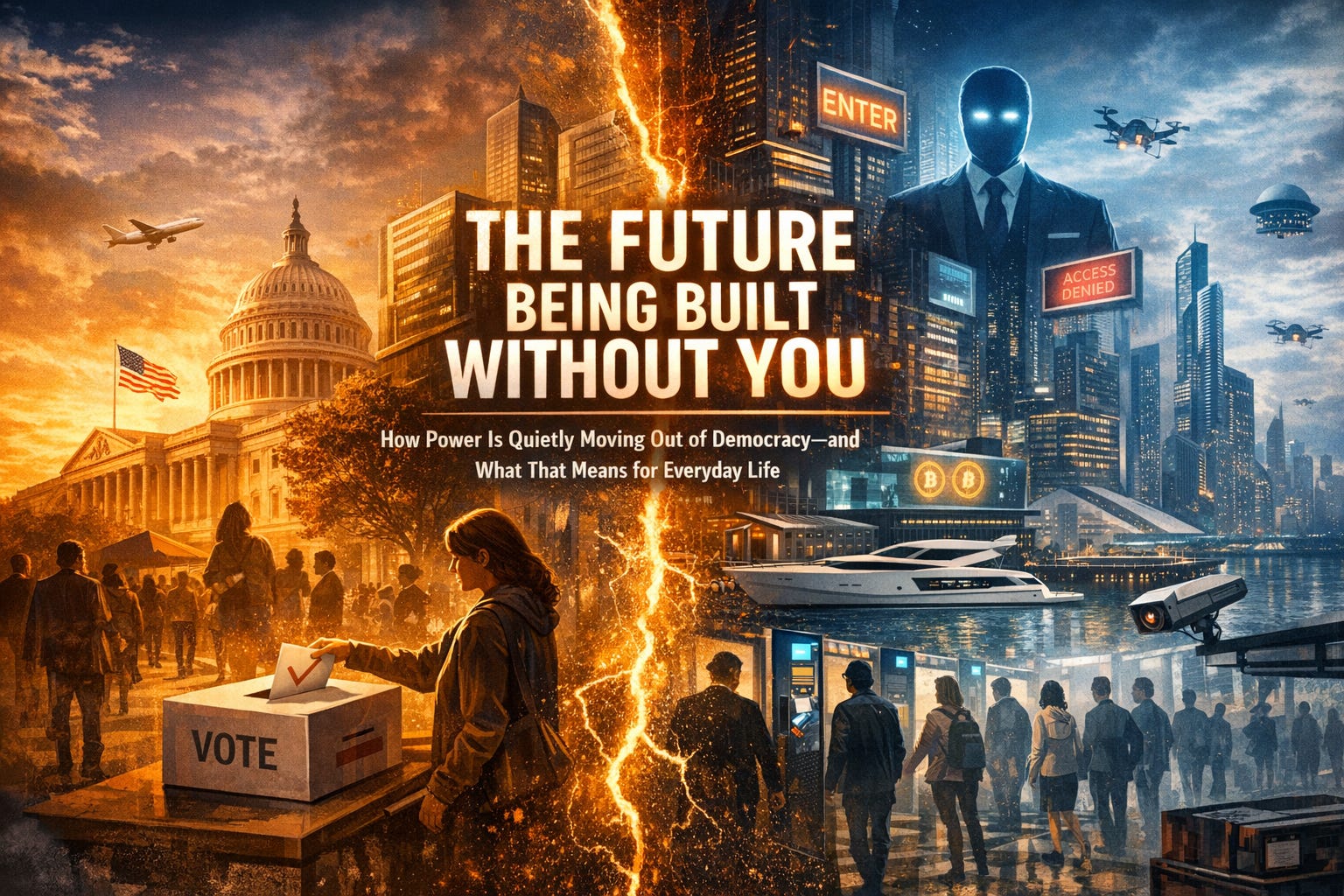
This article examines a shifting power dynamic where democratic participation is being replaced by technological and market-driven systems. Powerful elites are moving away from traditional governance to create exclusive, unaccountable structures that prioritize efficiency over human agency. In this new landscape, individuals are treated as users or assets rather than citizens, with algorithms quietly managing and sorting people based on their perceived value. This transition leads to a fragmented reality where the wealthy can opt out of shared societal burdens, leaving the majority to navigate a world they no longer help shape. Ultimately, the author warns that we are transitioning into an era of managed compliance where human consent is becoming an obsolete feature of social design.
The Future Being Built Without You
How Power Is Quietly Moving Out of Democracy, and What That Means for Everyday Life
Most people can feel it.
Politics feels louder but less meaningful.
Technology feels more powerful but less human.
Life feels more conditional, more expensive, more surveilled, more fragile.
We’re told these are just growing pains. That every generation feels disoriented by change.
But what if this time is different?
What if a new vision of the future is being deliberately built, one that no longer assumes most people should have a meaningful say in how society works?
From Citizens to Users
For generations, the basic promise of democracy was simple, even if imperfect:
You belong.
You count.
You have a voice.
That promise is now under quiet pressure, not from tanks or coups, but from a growing belief among powerful technologists and investors that democracy itself is obsolete.
To them, governments aren’t moral institutions. They’re systems. And like outdated software, they see liberal democracy as slow, bloated, and impossible to fix.
Their answer isn’t reform.
It’s exit.
Instead of trying to fix society together, they argue that freedom lies in leaving, leaving broken political systems and building new ones outside public accountability.
In this future, governance looks less like citizenship and more like a service.
You don’t belong because you’re a citizen.
You belong because you qualify.
Exit Sounds Like Freedom, Until You Ask Who Can Leave
“Exit” sounds empowering. Voluntary. Rational.
But here’s the question rarely asked:
Who can actually exit?
For the wealthy, mobile, and highly skilled, exit means choice.
For everyone else, it means exposure.
Most people can’t just relocate, recredential, or buy into elite systems. They have families, debts, health issues, and roots. Exit isn’t a button you press, it’s a privilege you afford.
In an exit-based world:
If you don’t like the rules, you’re told to leave.
If you can’t leave, that’s treated as your failure.
If the system harms you, there’s no appeal—only replacement.
This isn’t tyranny in the old sense.
It’s abandonment by design.
When Government Becomes a Business
In the world taking shape, governments are no longer meant to represent everyone. They’re meant to operate efficiently.
Like companies.
And companies optimize for:
profitability,
stability,
and desirable customers.
When a government starts thinking this way, people stop being citizens and start being assets.
Neighborhoods are optimized for property values, not community.
Policies are optimized for investment, not dignity.
Human worth becomes instrumental: what you produce, how predictable you are, how little friction you create.
You’re not asked what kind of society you want.
You’re measured for how much value you add.
AI Doesn’t Rule You, It Sorts You
A lot of people fear AI because they imagine sentient machines taking over.
That’s not the real danger.
AI’s real power is that it makes sorting people scalable.
Algorithms already decide:
who gets loans,
who gets jobs,
who gets flagged,
who gets ignored.
In the future being built now, these decisions won’t feel political. They’ll feel administrative. Neutral. Technical.
No one will argue with you.
No one will explain.
No one will be accountable.
The system will simply decide.
And when decisions are automated, responsibility disappears.
A World Without a Shared Reality
One of the quietest losses is the most profound: the loss of a common world.
There was a time, imperfect, but real, when rich and poor lived under the same laws, argued in the same political arena, and faced shared consequences.
That world is fragmenting.
Elites increasingly live under different rules, in different jurisdictions, with different escape hatches. The rest live where they can.
Humanity begins to split into parallel realities:
different laws,
different truths,
different futures.
Not through violence, but through architecture.
What Happens to Most People?
Most people won’t be crushed.
They’ll be managed.
There won’t be mass repression. Instead:
access quietly shrinks,
options narrow,
voices fade.
If you fail to meet the metrics, you’re not punished. You’re deprioritized.
That’s what makes the system stable.
People adapt instead of resisting.
Why Everything Feels So Exhausting
This future doesn’t ask you to participate. It asks you to cope.
So culture shifts away from collective action and toward self-management:
wellness replaces politics,
optimization replaces solidarity,
distraction replaces meaning.
You’re told to meditate.
To hustle.
To rebrand yourself.
To “upskill.”
All while the structure itself remains untouched.
This Isn’t an Accident
The most important thing to understand is this:
This future is not happening by accident.
It is being designed by people who believe:
democracy can’t be fixed,
inequality is natural,
most people should be managed, not consulted.
They are building systems that function without your consent, and increasingly, without your participation.
Quietly. Efficiently. Legally.
The Question That Actually Matters
The real question isn’t whether AI becomes conscious.
It isn’t whether democracy collapses overnight.
The real question is:
Do humans remain participants in shaping their shared future, or do they become users inside systems built by others?
Because once power is embedded in code, infrastructure, and contracts, it’s very hard to get back what was never explicitly taken.
Final Thought
This isn’t about left or right.
It’s not about loving or hating technology.
It’s about whether human agency remains a first-class value in the world now being built.
The future doesn’t arrive all at once.
It arrives quietly, system by system, choice by choice.
And the most dangerous moment is when people stop asking:
Who is this really for?
That moment is now.


