

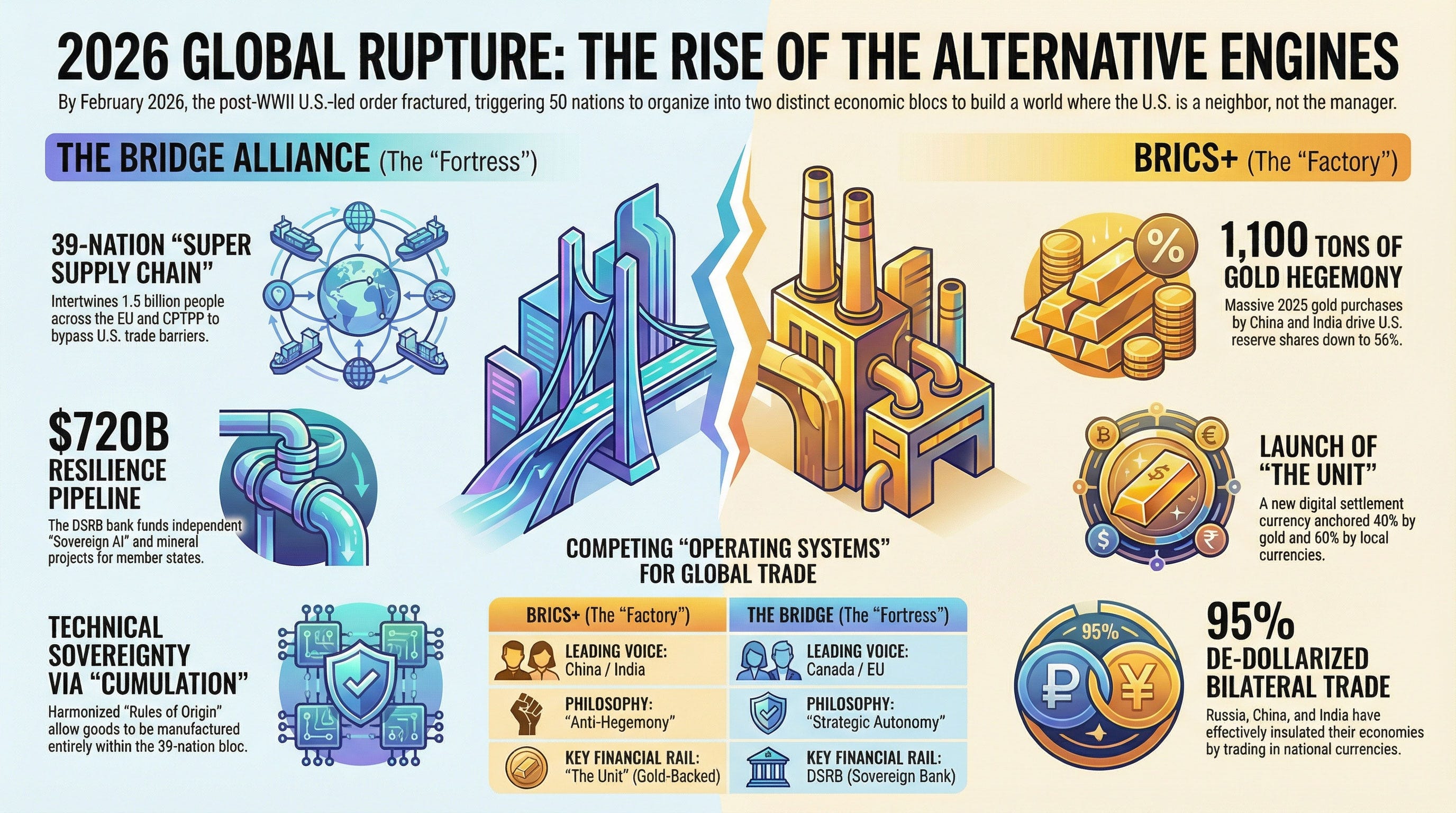
The dollar isn't "dying," but it is being demoted from "Global Manager" to "Regional Power." For the average American, this means higher costs for imports (inflation) but potentially more domestic manufacturing. For the rest of the world, it means they finally have a "Plan B."
1. The End of the Manager Era
The global economic volatility of early 2026 is no longer a mere market correction; it is a fundamental “rupture” in the post-WWII order. This shift was ignited by the January 2026 Greenland Crisis and formalized by Canadian Prime Minister Mark Carney’s searing address at Davos. Carney declared that the “bargain of American hegemony” has expired, as Washington moved from providing global stability to weaponizing integration for land acquisition and narrow tactical gains.
The world has stopped waiting for a return to American normalcy and has instead executed a systemic divorce. This “Plan B” is not a temporary hedge but a permanent reconfiguration of sovereignty, where middle powers no longer view their security as a line item in a foreign budget.
2. The Rise of the “Bridge Alliance”: A 39-Nation Economic Fortress
The most sophisticated response to American trade volatility is the “Bridge Alliance,” a massive 1.5 billion-person economic garrison. Spearheaded by Carney, this bloc merges the 27 nations of the European Union with the 12 nations of the Comprehensive and Progressive Agreement for Trans-Pacific Partnership (CPTPP). By pooling the credit ratings and industrial capacities of nations like Germany, Japan, and Canada, the alliance has created a market large enough to be “un-bullyable.”
This is a geopolitical insurance policy designed to absorb trade shocks and respond to unilateral coercion as a single, massive unit. It moves beyond the concept of “free trade” into the realm of collective resilience, ensuring that no member can be isolated and picked off by “Liberation Day” tariffs.
“We are in the midst of a rupture, not a transition. Allied nations will diversify to hedge against uncertainty and rebuild sovereignty through collective resilience. You cannot live within the lie of mutual benefit when integration becomes the source of your subordination.” — Mark Carney
3. The Dollar’s Demotion: A Tactical Retreat from the Global Garrison
The U.S. dollar is undergoing a “strategic thinning,” losing its long-held monopoly as the world’s master key. While the dollar remains a formidable currency, it has been demoted from “Global Manager” to a “Regional Neighbor.” U.S. dollar reserves have slipped to 56.9% as central banks pivot toward gold and local currency settlement to avoid the risk of sudden sanctions or asset freezes.
The global economy is now operating on three competing systems: the U.S. Digital Dollar (and its strategic Bitcoin reserve), the Bridge multi-currency system, and the BRICS gold-backed “Unit.” This fragmentation marks the end of the era where all roads led to Washington, replacing it with a world where other nations have forged their own keys.
Gold as the Anti-Dollar: Reflecting the flight from “paper promises,” gold has shattered records to reach $4,600 per ounce in early 2026.
4. Technical Sovereignty: The Legal Wall of “Rules of Origin”
The Bridge Alliance’s most potent weapon is the counter-intuitive technical maneuver known as “cumulation” and “rules of origin.” By harmonizing these rules, the 39 nations have created a “super supply chain” where components from any member are treated as “local.” This allows for the creation of an industrial ecosystem that bypasses U.S. borders entirely.
This technicality functions as a legal wall. A car can now be manufactured in Japan using Canadian steel and German electronics, then sold in Mexico tariff-free, without a single U.S. component, a single drop of U.S. oil, or a single U.S. chip. It is a system designed to make American leverage irrelevant.
5. The DSRB: A “World Bank for Security”
To finance this strategic autonomy, the alliance launched the Defence, Security, and Resilience Bank (DSRB). This AAA-rated multilateral lender acts as the financial engine for “re-industrialization,” funding ITAR-free technology and critical mineral mines. The bank’s “Member-State Priority” rule effectively forces industrial giants like Airbus and Leonardo to strip out U.S. parts to qualify for low-interest capital.
The most visible success is the “Bromo Project,” a €500 million joint venture between Airbus, Leonardo, and Thales. By merging their space divisions to build 100% ITAR-free satellites, these firms have eliminated Washington’s ability to veto their sales. They are now positioning themselves to control the “energy-AI” nexus through independent hydro and nuclear grids that support Sovereign AI data centers.
“We are in a new era where we must build what we need with the partners we trust. The DSRB ensures that our security is not a line item in someone else’s budget.” — Carney-Starmer Joint Statement
6. The “Greenland Crisis” as the Death of Trust
The definitive catalyst for this realignment was the January 2026 Greenland incident, where the U.S. administration threatened a 25% “access tax” on European allies unless Denmark ceded the territory. This transactional view of an ally’s sovereignty was the final straw. In an unprecedented diplomatic shift, the Danish Intelligence Service officially designated the U.S. as a “potential security risk.”
The response was the “Arctic Sentry” mission, a purely European-Canadian defense of the High North. Sweden has deployed the “Gripen Shield”—JAS 39 fighter jets stationed in Iceland, while Finland has established the “Lapland Fortress” to secure the land bridge to the Arctic. To ensure a “Digital Shield,” a new sub-sea cable now connects Nuuk to Iqaluit, bypassing U.S. hubs to protect transatlantic data from tampering.
7. BRICS+: The “Alternative Engine” of the Global South
While the Bridge Alliance builds its “Fortress,” BRICS+ has established itself as the global “Factory.” As of February 2026, the bloc has de-dollarized 90-95% of trade between Russia, China, and India. Their primary tool is “The Unit,” a digital settlement rail backed 40% by gold and 60% by a basket of local currencies.
Though the Bridge and BRICS have different philosophies, they share the same goal: insulation from U.S. financial coercion. While the Bridge focuses on high-tech manufacturing and AAA credit, BRICS controls 40% of global oil and 50% of the population, creating a twin-pincer movement that leaves the U.S. economy increasingly isolated.
8. Conclusion: The Price of Isolation
The “Great Decoupling” of 2026 has brought the costs of “America First” home to the American consumer. The EU has readied its €93 Billion “Trade Bazooka,” a retaliatory list targeting everything from Bourbon and Harley-Davidson to luxury cosmetics and tech. This is not a warning; it is a coordinated economic strike designed to maximize political pressure.
The tangible impact on the American public is a staggering inflationary shock. As global supply chains bypass the U.S., import costs are surging, with vehicle prices projected to hike by $4,000 to $10,000 per unit. The ultimate question of 2026 is whether the United States can truly be “great” alone in a world that has successfully built its own redundancy system, leaving Washington to wonder if being a “powerful neighbor” is a lonely substitute for being the world’s indispensable manager.