

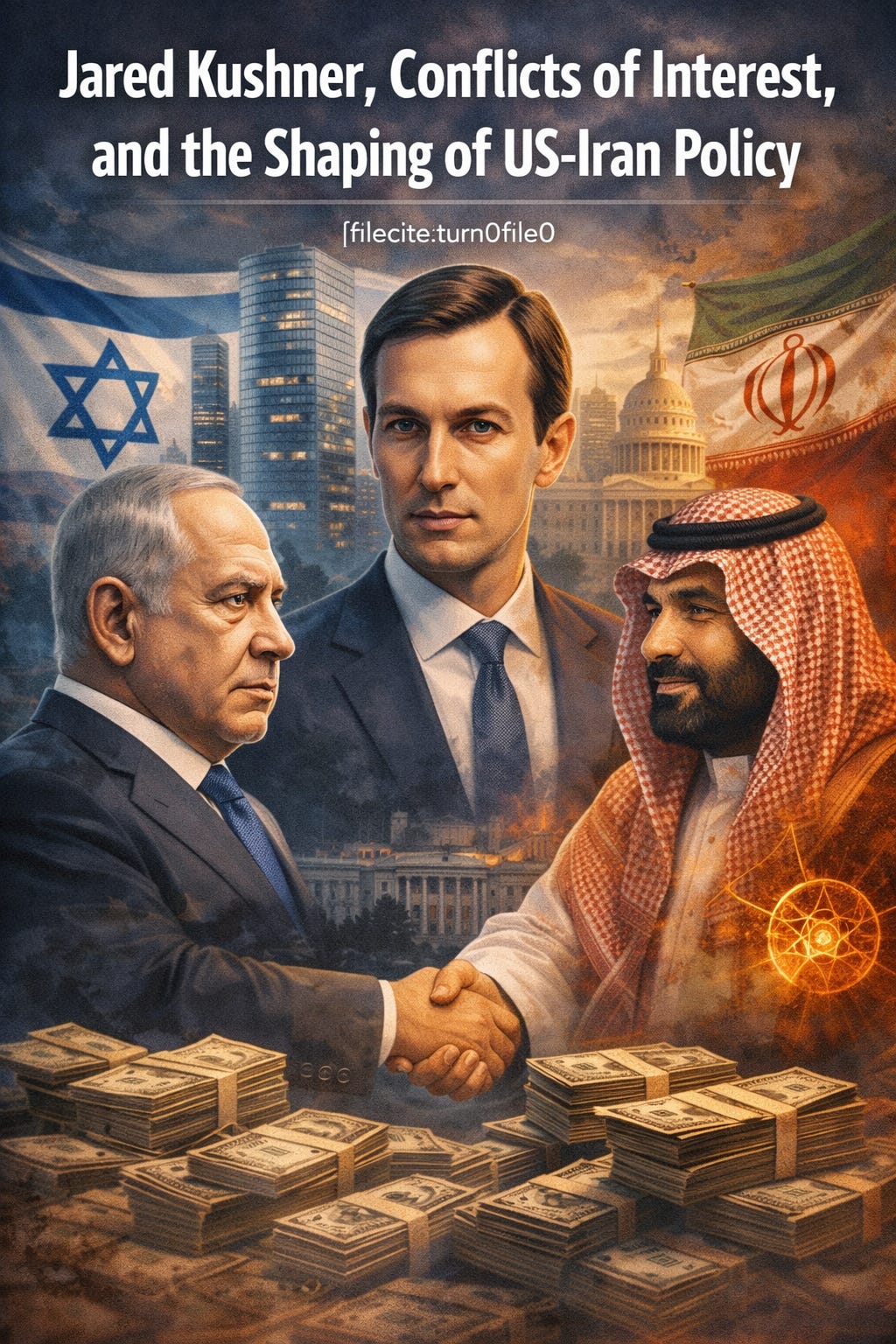
An investigation into Jared Kushner’s dual roles as presidential advisor and private equity CEO, and the financial architecture reshaping US-Iran policy
Introduction: When “Conflicts of Interest” Become “Trusted Relationships”
The phrase “conflict of interest” carries legal and ethical weight in American governance. But as one insider reportedly reframed it: “What people call conflicts of interest, Steve and I call experience and trusted relationships.” This linguistic pivot sits at the heart of a profound transformation in how American foreign policy intersects with private capital, and nowhere is this more consequential than in the case of Jared Kushner.
Since leaving the White House in early 2021, Kushner has built a financial empire anchored by Affinity Partners, a private equity firm that has raised over $3 billion, with 99% of capital coming from overseas sources, predominantly the Saudi Public Investment Fund. In 2021, Saudi Arabia committed $2 billion to Kushner’s fledgling fund despite internal screening panels flagging concerns about his lack of asset management experience, excessive fee structures, and “public relations risks” stemming from his prior government role.
This article examines the verified facts surrounding Kushner’s relationships with Israeli Prime Minister Benjamin Netanyahu and Saudi Crown Prince Mohammed bin Salman (MBS), his investment strategy linking Gulf capital to Israeli markets, and the allegations that these financial interests influenced US policy toward Iran during the 2025-2026 negotiations.
Part I: The Netanyahu Connection, From Childhood Bedroom to Strategic Partnership
A Relationship Forged in Intimacy
Buried in a 2017 New York Times profile was a detail that has resurfaced with renewed significance: when Benjamin Netanyahu visited the United States during Kushner’s teenage years, he stayed at the Kushner family home in New Jersey. “Most diplomats meet foreign leaders at negotiating tables,” one commentary noted. “Jared Kushner met Benjamin Netanyahu when Netanyahu was sleeping in his bed, forcing Jared to sleep in the basement.”
While this anecdote has circulated in media reports, its verification comes from Haaretz’s coverage of the same Times profile, which confirmed that “Netanyahu has long been a friend of the Kushners, and particularly Jared’s dad, Charles Kushner, a major donor to pro-Israel and Jewish causes”. The relationship was not merely social; a leaked list reportedly written by Netanyahu identified Charles Kushner among top potential donors, suggesting early strategic recognition of the family’s influence.
From Personal Ties to Policy Influence
This personal history took on new dimensions during Trump’s first term, when Kushner served as senior advisor and played a central role in brokering the Abraham Accords. But the relationship’s significance extends beyond diplomacy. In 2024, Kushner’s Affinity Partners acquired a $128.5 million stake in Phoenix Holdings Ltd., Israel’s largest insurance and financial services company. By January 2025, Israeli regulators approved Affinity’s request to double that stake.
Phoenix Holdings has faced scrutiny for investments linked to Israeli settlements in occupied territories. While Kushner’s fund does not directly manage settlement financing, its position as Phoenix’s largest shareholder creates an indirect financial conduit between Gulf capital and Israeli economic infrastructure, a dynamic Kushner himself has framed as building an “investment corridor between Saudi Arabia and Israel.”
Part II: The Saudi Pipeline, $2 Billion and the Architecture of Influence
The Unprecedented Investment
Kushner launched Affinity Partners in Miami shortly after leaving the White House, despite having no prior experience in private equity or asset management. Yet within months, Saudi Arabia’s sovereign wealth fund committed $2 billion, the fund’s largest single investment. According to Senate Finance Committee investigations, the Saudi screening panel had documented serious reservations:
“The inexperience of the Affinity Fund management; the possibility that the kingdom would be responsible for ‘the bulk of the investment and risk’; due diligence on the fledgling firm’s operations that found them ‘unsatisfactory in all aspects’; a proposed asset management fee that ‘seems excessive’; and ‘public relations risks’”.
Despite these red flags, Crown Prince Mohammed bin Salman proceeded with the investment. Observers have questioned whether this represented a return of political favors: Kushner had reportedly defended MBS within the White House following the 2018 murder of journalist Jamal Khashoggi.
The Financial Corridor Strategy
Kushner’s investment thesis explicitly targets the normalization of economic ties between Gulf states and Israel. As reported by The Cradle, “Kushner, leveraging those Netanyahu and MBS relationships, said he wanted to open a quote investment corridor between Saudi Arabia and Israel”.
This strategy has tangible outcomes: Affinity Partners’ investments in Israeli companies like Phoenix Holdings create financial infrastructure that aligns Gulf capital with Israeli economic growth. Every dollar flowing through this channel strengthens commercial interdependence between states that were once historic rivals, and, critics argue, builds a regional coalition structurally opposed to Iranian influence.
As Netanyahu himself stated: “Saudi Arabia will have a lot to gain. I think all these countries around Iran are threatened by Iran and I think peace between Israel and Saudi Arabia would be really possible and probably uh very close”.
Part III: Iran Negotiations, Where Policy, Intelligence, and Personal Interest Converge
The February 2026 Crossroads
In early 2026, diplomatic channels suggested progress in US-Iran nuclear talks. According to Wikipedia’s documentation of the 2025-2026 negotiations, Britain’s national security adviser Jonathan Powell attended the Geneva talks and “judged that Tehran’s offer on its nuclear programme was significant enough to prevent a rush to war”. Powell reportedly described the Iranian proposal as “surprising” and believed a deal remained achievable.
Yet the talks collapsed. On February 28, 2026, the United States and Israel launched large-scale military operations against Iran.
Allegations of Conflicted Counsel
Multiple reports have raised questions about Kushner’s role in advising President Trump during this critical period:
According to The Guardian, a diplomat with direct knowledge of the Geneva talks stated: “We regarded Witkoff and Kushner as Israeli assets that dragged a president into a war he wants to get out of”.
Popular Information reported that while diplomats from Britain and Oman indicated a deal was close, “Kushner told Trump there was no chance of a deal and that Iran was about to attack the United States”, a claim contradicted by Pentagon briefings to congressional staff indicating Iran had no plans to strike US forces.
Senate investigators have questioned whether Kushner’s financial ties to Saudi Arabia and his investments in Israeli companies created incentives to undermine diplomacy that might have preserved Iranian leverage in the region.
These allegations remain contested. Kushner’s representatives have not publicly addressed the specific claim that he misrepresented Iranian intentions to the President. What is documented, however, is the structural conflict: Kushner simultaneously served as an informal US negotiator while managing a fund whose largest investors, Saudi Arabia, the UAE, and Qatar, have strategic interests in containing Iranian influence.
The Financial Logic of Escalation
Critics argue that Kushner’s investment strategy benefits from regional configurations that marginalize Iran. As one analysis noted: “He is the corridor. Saudi money flowing through Kushner into the Israeli economy is the financial infrastructure of a new Middle East reentered around Gulf Israeli ties and every dollar that flows through it builds a region that doesn’t want Iran at the table”.
If diplomatic engagement with Iran succeeded, it could:
Reduce regional tensions that justify Gulf military spending
Potentially reintegrate Iran into regional economic frameworks
Undermine the strategic rationale for the Saudi-Israeli normalization Kushner’s fund is positioned to monetize
Conversely, sustained confrontation with Iran:
Reinforces Gulf states’ security dependence on US alliances
Accelerates economic integration between Israel and Gulf monarchies
Increases the value of financial infrastructure linking these partners, infrastructure Kushner’s fund helps build
Part IV: The Broader Pattern, When Personal Networks Become Policy Infrastructure
The “Experience and Trusted Relationships” Framework
The reframing of conflicts of interest as “trusted relationships” reflects a broader shift in how influence operates in contemporary governance. Kushner’s case illustrates three interconnected dynamics:
Temporal Blurring: The line between public service and private enterprise has dissolved. Kushner’s government relationships became business assets immediately upon leaving office.
Geographic Arbitrage: Kushner leverages relationships across multiple jurisdictions (US, Israel, Saudi Arabia) where disclosure requirements and ethical standards vary, creating regulatory gaps.
Narrative Control: By framing financial interests as aligned with ideological commitments (”Kushner’s ideology was there long before the money was”), the appearance of conflicted decision-making is recast as principled consistency.
Institutional Responses
US oversight mechanisms have struggled to address these novel configurations:
The Senate Finance Committee, led by Chairman Ron Wyden, has investigated whether Kushner’s fund serves as “a potential tool for foreign governments to curry favor with a possible future Trump administration”.
Ethics experts note that current conflict-of-interest laws were designed for traditional employment relationships, not for advisors who simultaneously manage investment funds capitalized by foreign governments.
Transparency advocates argue that Kushner’s dual roles create information asymmetries: he possesses non-public policy insights that could benefit his fund’s investment decisions, while his fund’s foreign investors gain privileged access to US policy formulation.
Conclusion: Reconciling Influence and Accountability
The Kushner case forces a reckoning with fundamental questions about democratic governance in an era of globalized capital:
Can personal relationships that predate public service be ethically leveraged for policy influence? The Netanyahu connection illustrates how childhood acquaintances can evolve into channels of statecraft, with both diplomatic benefits and accountability risks.
Should former officials be permitted to monetize relationships cultivated in government? The $2 billion Saudi investment in Affinity Partners raises this question acutely, particularly given the screening panel’s documented concerns.
How do we assess policy decisions when decision-makers have financial stakes in particular outcomes? The Iran negotiations highlight the difficulty of disentangling genuine security assessments from interests aligned with specific geopolitical configurations.
What emerges is not a simple narrative of corruption, but a more complex picture of how influence operates in contemporary statecraft. Kushner’s investments in Israeli companies, his relationships with Gulf leaders, and his policy advocacy are mutually reinforcing elements of a coherent strategy, one that advances both his financial interests and his ideological vision for the Middle East.
The challenge for democratic institutions is to develop frameworks that acknowledge the reality of networked influence while preserving accountability. As one Senate investigator put it: the question is not whether Kushner’s ideology preceded his financial interests, but whether “the money aligned financial interests perfectly with ideology” in ways that shaped decisions affecting millions.
Until governance structures evolve to address these hybrid public-private roles, cases like Kushner’s will continue to test the boundaries of ethical statecraft, and the public’s trust in the institutions meant to serve them.
Sources: This article synthesizes reporting from Haaretz www.haaretz.com www.jpost.com, The Cradle thecradle.co, Popular Information www.finance.senate.gov popular.info, Senate Finance Committee investigations www.ms.now www.finance.senate.gov, TRT World/The Guardian www.trtworld.com [[TRT World report]], and Wikipedia’s documentation of the 2025-2026 Iran negotiations en.wikipedia.org
Specific claims about Kushner’s advice to President Trump regarding Iran remain attributed to diplomatic sources and have not been independently verified by US government records.