

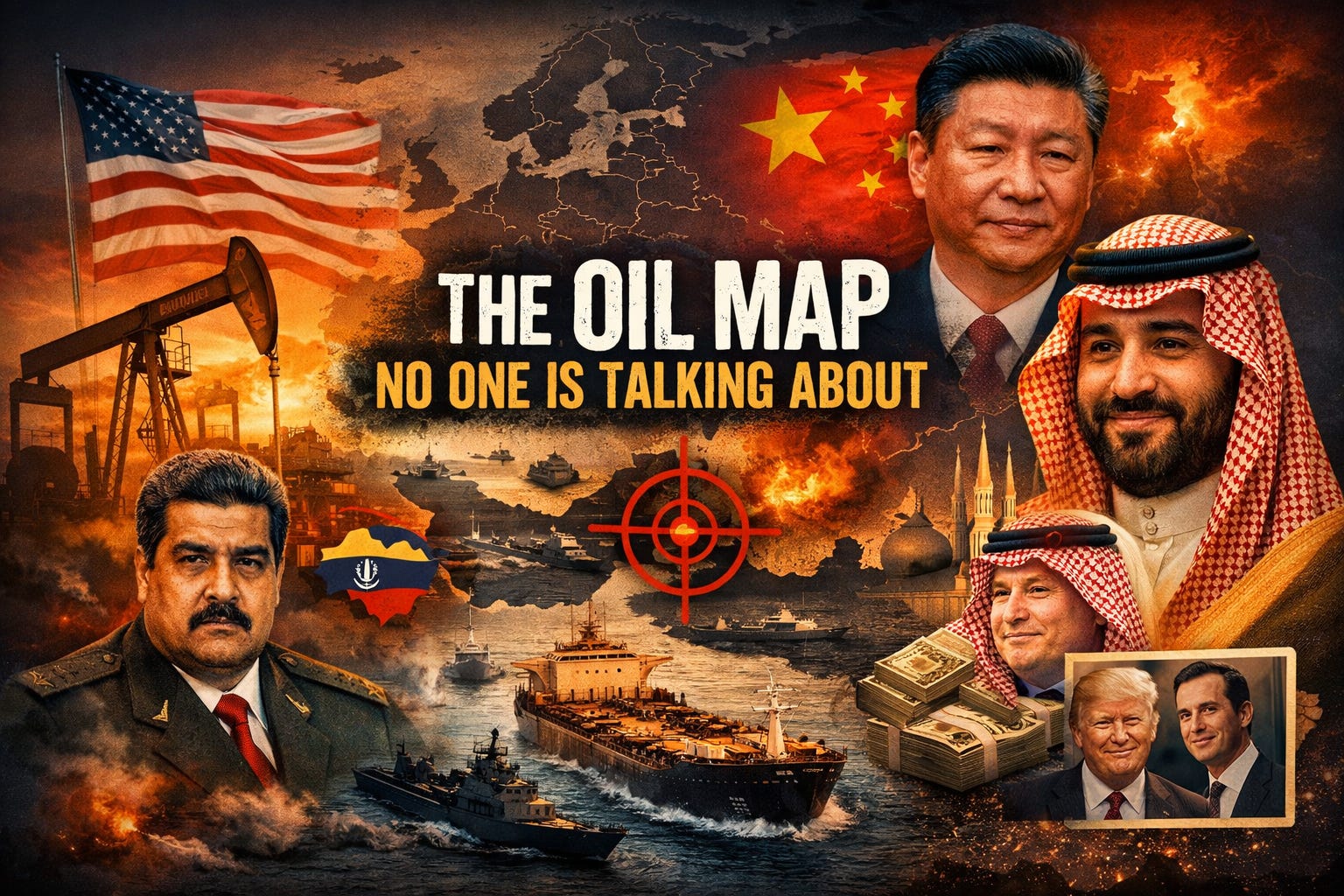
There’s a moment in every geopolitical crisis where people start connecting dots.
Sometimes those dots form real patterns.
Sometimes they form conspiracies.
But occasionally… they form a question that deserves to be asked.
Right now, the global energy map is shifting in ways that look suspiciously strategic.
Let’s walk through it.
Step 1 - The World’s Largest Oil Reserve Suddenly Changes Hands
At the center of the story is Venezuela.
The country holds the largest proven oil reserves on Earth, larger even than Saudi Arabia.
Yet for years, those reserves have been underproduced due to sanctions, infrastructure collapse, and political instability.
Then something remarkable happened.
The United States took operational control over Venezuelan oil export management following the capture of Venezuelan leader Nicolás Maduro.
That didn’t mean American tankers started loading Venezuelan crude.
But it did mean the U.S. now influences where those barrels go and where the money flows.
In the oil world, that’s power.
Step 2 - The China Oil Equation
Now zoom out.
China is the world’s largest oil importer.
And it gets that oil from a web of suppliers, including:
Russia
Saudi Arabia
Iraq
Iran
Brazil
But here’s the important detail:
China has been stockpiling massive oil reserves, estimated to be roughly 100 days of import coverage.
Why would a country do that?
Usually for one reason:
They think supply could become unstable.
Step 3 - The Chokepoint That Powers the Planet
Enter the most important shipping lane in global energy:
The Strait of Hormuz.
Nearly 20% of the world’s oil supply moves through this narrow corridor between Iran and the Arabian Peninsula.
Any disruption there can spike global prices overnight.
And right now, tensions involving Iran and Western militaries are focused heavily on the naval capabilities that protect or threaten that shipping lane.
This is where geopolitics and energy collide.
Step 4 - The Saudi Paradox
Now things get more complicated.
While Iran and Venezuela have been under pressure…
Saudi Arabia is thriving.
The kingdom is:
One of the largest oil suppliers to China
The largest recipient of U.S. arms exports in recent years
A central player in global oil pricing
At the same time, Saudi financial investments have appeared in unexpected places.
For example:
The Saudi sovereign wealth fund, the Public Investment Fund, invested $2 billion in the investment firm Affinity Partners run by Jared Kushner.
Meanwhile, new Trump-branded developments in Saudi Arabia are being built through partnerships between Dar Global and The Trump Organization.
These projects are worth billions.
None of this proves corruption.
But it does raise eyebrows.
Step 5 - The GDP Question
Another layer of the puzzle involves the American economy.
According to the Bureau of Economic Analysis, U.S. GDP growth in late 2025 included some contribution from defense spending.
But the numbers tell a more nuanced story.
Defense spending was not the primary driver of economic growth.
Consumer spending and private investment remain far larger factors.
Still, whenever geopolitical tensions rise, defense industries inevitably expand.
And major buyers, like Saudi Arabia, benefit from that supply.
So What’s Actually Happening?
There are two possibilities.
Possibility One
This is simply the normal chaos of global geopolitics:
energy markets shifting
wars and sanctions reshaping supply
governments reacting to crises
No grand strategy.
Just complex systems colliding.
Possibility Two
Energy security is quietly being used as a strategic lever in the competition between major powers.
In that scenario, controlling oil flows becomes a way to influence economic rivals.
The Reality
The truth is likely somewhere in between.
The world’s energy system is too interconnected for a single actor to control completely.
But governments absolutely do maneuver within it for advantage.
What matters is not a single conspiracy…
…but the structure of incentives.
And right now, those incentives revolve around three things:
Oil supply
Shipping lanes
Great power competition
Why This Matters
Oil still powers the modern world.
Control the energy…
and you influence the economy.
Influence the economy…
and you influence geopolitics.
The question isn’t whether governments think this way.
They always have.
The question is whether we are watching a deliberate energy strategy unfold…
or simply the latest chapter in the endlessly messy politics of oil.
Either way, the map is shifting.
And most people haven’t noticed yet.