

Information Warfare — Information War — An Analytical Framework
Introduction: The Intersection of War, Wealth, and Power
When military conflict erupts in oil-rich regions, the consequences ripple far beyond the battlefield. Energy prices fluctuate, financial markets react, and political narratives shift. For citizens observing these dynamics, legitimate questions arise: Who benefits from escalation? How do policy decisions align with private interests? And what mechanisms exist to ensure transparency and accountability?
This article examines the complex relationship between U.S. foreign policy, global oil markets, and political influence, addressing concerns about war profiteering, conflicts of interest, and the human cost of geopolitical strategy. We ground our analysis in documented patterns, historical precedent, and verifiable data, distinguishing between confirmed facts, credible allegations, and speculative claims.
Methodological Note: This analysis relies on publicly available records, financial disclosures, historical precedent, and peer-reviewed research. Where allegations are cited, we note their evidentiary status. Our goal is not to amplify unverified claims, but to provide frameworks for critical inquiry.
Part I: The Historical Pattern, War, Oil, and Financial Interests
The Military-Industrial-Energy Complex
The relationship between defense policy and energy markets is not new.
Historical precedents include:
1. The 1973 Oil Embargo
Arab OPEC nations cut oil exports to the U.S. following American support for Israel in the Yom Kippur War
Oil prices quadrupled, triggering global recession
U.S. policymakers subsequently prioritized energy security and Middle East alliances
2. The 1991 Gulf War
Iraq’s invasion of Kuwait threatened global oil supplies
U.S.-led coalition intervened; oil prices stabilized post-conflict
Defense contractors saw significant revenue increases
3. The 2003 Iraq Invasion
Pre-war oil prices: ~$25/barrel; Post-invasion peak (2008): ~$147/barrel
Halliburton (formerly led by Vice President Dick Cheney) received billions in no-bid contracts
Congressional investigations examined contracting practices, though few criminal charges resulted
Documented Pattern: Military interventions in oil-producing regions consistently correlate with:
Short-term oil price volatility
Increased defense/energy sector revenues
Policy decisions that align with strategic resource access
The “Revolving Door” Phenomenon
Government officials frequently transition between public service and private sector roles in defense, intelligence, and energy:
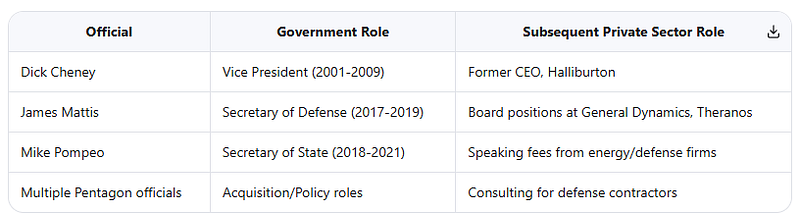
Source: OpenSecrets.org, Center for Responsive Politics; Government Accountability Office reports
This pattern raises legitimate questions about policy motivations, though direct quid-pro-quo corruption requires specific evidence.
Part II: Oil Markets and Geopolitical Conflict — How Prices Actually Move
The Mechanics of Oil Price Volatility
Oil is a globally traded commodity priced based on:
Supply/Demand fundamentals: Production levels, consumption trends, strategic reserves
Geopolitical risk premiums: Perceived threats to supply routes or producing nations
Financial speculation: Futures markets, algorithmic trading, institutional investment
Currency fluctuations: Oil priced in USD; dollar strength affects affordability
When conflict erupts in the Middle East:
Traders anticipate potential supply disruptions
“Risk premium” added to prices (often $5–20/barrel)
Speculative buying can amplify initial moves
Prices may fall if conflict proves limited or supply remains intact
Russia, Sanctions, and Market Adaptation
The claim that “sanctions magically disappear” warrants scrutiny:
Documented Reality (2022–2026):
Western sanctions on Russian oil created market fragmentation
Russia redirected exports to India, China, Turkey at discounted prices
“Shadow fleet” of tankers emerged to circumvent price caps
Global prices remained elevated but did not collapse due to supply adaptation
Key Insight: Sanctions are rarely absolute. Markets find pathways around restrictions, often benefiting intermediaries and creating opaque financial flows. This does not imply conspiracy, but rather the adaptive nature of global commodity markets.
Intelligence Sharing in Conflict Zones
The allegation that “Russia is feeding Iran intelligence” intersects with documented patterns:
Verified Context:
Russia and Iran cooperate militarily in Syria (since 2015)
Both oppose U.S. regional presence; tactical coordination occurs
Intelligence sharing between adversarial states is common in multipolar conflicts
Unverified Claim: Specific, real-time intelligence transfers during the 2026 Iran conflict would require confirmation from intelligence agencies or credible whistleblowers. Absent such evidence, this remains plausible but unconfirmed.
Part III: Political Accountability and Financial Disclosure
Campaign Finance, Investments, and Conflicts of Interest
U.S. law requires certain financial disclosures, but gaps remain:
What Is Public:
Presidential/vice-presidential financial disclosures (blinded trusts permitted)
Congressional stock trades (reported within 45 days per STOCK Act)
Lobbying registrations and expenditures
What Is Opaque:
Family member investments (spouses, adult children)
Blind trust holdings (beneficiaries don’t know specific assets)
Private equity, venture capital, and offshore holdings
The Baron Trump Investment Claim: A Case Study in Verification
Allegation: “Baron Trump invested $30M in oil; value rose to $500M after bombing Iran.”
Verification Framework:
Source: Is this from SEC filings, credible journalism, or anonymous social media?
Timeline: Can investment dates be correlated with policy decisions?
Magnitude: A $470M return on $30M (~1,500%) in days would be extraordinary, requiring leverage, insider timing, or market manipulation.
Public Records: Presidential family financial disclosures are limited; adult children’s finances are rarely public.
Responsible Conclusion: Without verifiable documentation, this claim cannot be confirmed. However, the pattern of political families benefiting from policy-aligned investments is a legitimate subject for journalistic investigation and regulatory reform.
Journalistic Standard: Extraordinary claims require extraordinary evidence. Absent documentation, we note the allegation while emphasizing the need for transparency reforms.
Part IV: The Human Cost — Civilians, Soldiers, and Moral Responsibility
The Disproportionate Burden of War
While financial markets react in milliseconds, human consequences unfold over years:
Documented Impacts of Middle East Conflicts:
Civilian casualties: UN OCHA reports tens of thousands of non-combatant deaths in recent Gaza/Iran-related operations
Displacement: Millions of refugees across Syria, Yemen, Palestine
Economic devastation: Infrastructure destruction, healthcare collapse, generational trauma
Veteran outcomes: PTSD, traumatic injury, suicide rates among U.S. service members
The “Fog of War” and Narrative Control
Political leaders often frame conflicts using:
Threat inflation: Exaggerating imminent dangers to justify action
Moral clarity: Framing complex conflicts as good vs. evil
Blame diffusion: Attributing decisions to advisors, intelligence, or allies
This is not unique to any administration. Historical examples include:
Gulf of Tonkin (1964): Questionable intelligence used to escalate Vietnam War
Iraq WMD claims (2003): Discredited intelligence used to justify invasion
“Imminent threat” rhetoric: Common justification across administrations
Critical Question: How can citizens discern genuine threats from political manipulation?
Part V: Frameworks for Accountability and Reform
Strengthening Transparency Mechanisms
Policy Recommendations Supported by Good-Government Groups:
1- Expand Financial Disclosure
Require real-time reporting of congressional stock trades
Extend disclosure requirements to immediate family members of senior officials
Prohibit trading in sectors directly affected by official duties
2- Reform Lobbying and Revolving Door Practices
Extend cooling-off periods for officials entering private sector (currently 1–2 years)
Ban lobbying by former senior officials on matters they oversaw
Publicly fund elections to reduce dependence on industry donations
3- Strengthen War Powers Oversight
Require explicit congressional authorization for sustained military action
Mandate regular public reporting on conflict objectives, costs, and outcomes
Establish independent bodies to assess intelligence used to justify force
4- Protect Whistleblowers and Investigative Journalism
Strengthen legal protections for those exposing waste, fraud, or abuse
Ensure FOIA requests are processed promptly and comprehensively
Support nonprofit investigative journalism focused on accountability
Civic Engagement: What Citizens Can Do
Demand Transparency: Contact representatives supporting disclosure reforms
Support Investigative Media: Subscribe to outlets prioritizing accountability journalism
Engage in Local Politics: Municipal and state elections shape national policy pipelines
Practice Media Literacy: Verify claims before sharing; distinguish reporting from opinion
Center Human Impact: Advocate for policies prioritizing civilian protection and diplomatic solutions
Conclusion: Beyond Cynicism Toward Constructive Accountability
The frustrations expressed in the original query reflect legitimate concerns:
War can enrich powerful interests while harming vulnerable populations
Political narratives may obscure complex motivations
Financial systems can reward those with insider access
However, addressing these issues requires more than outrage — it demands:
Rigorous verification of specific allegations
Systemic reforms to increase transparency and accountability
Civic engagement to shift policy priorities
Moral clarity that centers human dignity over geopolitical gamesmanship
“The price of liberty is eternal vigilance.”, Often attributed to Thomas Jefferson
Vigilance means asking hard questions, demanding evidence, and refusing to accept “that’s just how things work.” It also means channeling justified anger into constructive action: supporting investigative journalism, advocating for reform, and building movements that prioritize peace, justice, and accountability.
The magician’s trick only works if the audience looks away. Keep watching. Keep asking. Keep demanding better.
Sources for Further Research
Transparency & Accountability:
OpenSecrets.org (campaign finance, lobbying data)
Government Accountability Office (GAO) reports
Project On Government Oversight (POGO)
Sunlight Foundation archives
Oil Markets & Geopolitics:
U.S. Energy Information Administration (EIA)
International Energy Agency (IEA) reports
Oxford Institute for Energy Studies
Journal of Energy Security
War Powers & Foreign Policy:
War Powers Resolution (1973) text and analysis
Congressional Research Service reports on military authorizations
Costs of War Project (Brown University)
Media Literacy & Verification:
Poynter Institute fact-checking resources
Stanford History Education Group: Civic Online Reasoning
AllSides.com: Media bias transparency
Disclaimer: This article analyzes patterns and systemic issues. Specific allegations about individuals require verification through official records or credible investigative reporting. We encourage readers to consult primary sources and support journalism that holds power accountable.