

From the 1973 oil embargo to the Trump administration's confrontation with Iran
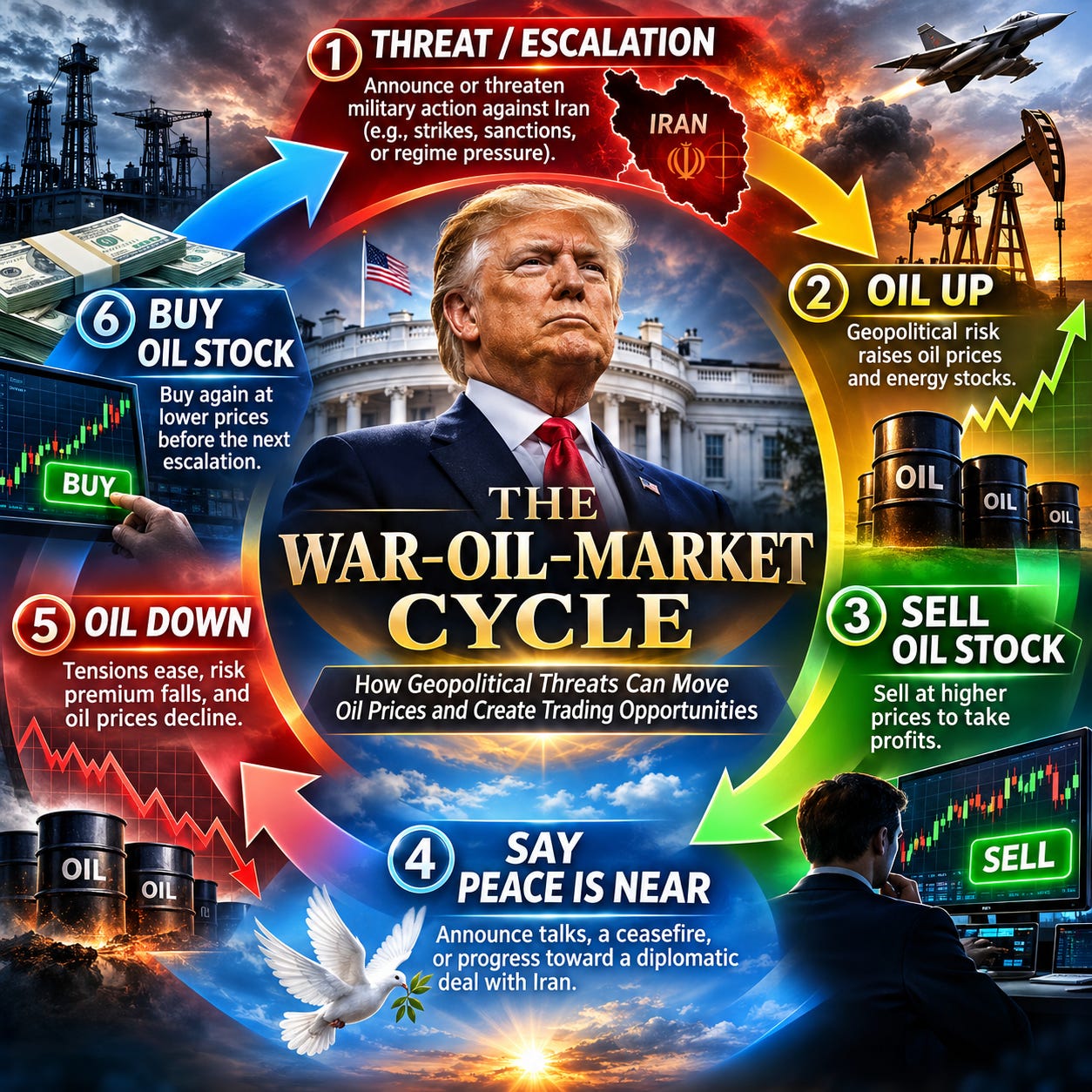
The cycle is straightforward: threaten military action against Iran, oil prices rise, investors sell at higher prices, announce progress toward peace, oil prices decline, and investors buy again before the cycle repeats.
History confirms that geopolitical threats, military actions, and diplomatic announcements can move oil markets dramatically. What history does not establish is that these events are deliberately orchestrated as a coordinated stock-trading strategy.
Understanding the distinction requires examining more than fifty years of interactions among government policy, military conflict, energy markets, and financial interests.
1. The historical origins: Oil becomes an instrument of geopolitical power
1973–1974: The Arab oil embargo
The modern relationship between geopolitical conflict and energy prices became unmistakable during the 1973 Arab–Israeli War.
Arab oil-producing countries restricted petroleum supplies and imposed an embargo against the United States and certain other countries supporting Israel.
The consequences included sharply higher oil prices, inflation, fuel shortages, and economic disruption.
This was a defining moment: governments discovered that access to energy could be used as geopolitical leverage, while financial markets learned to price political instability into petroleum contracts.
The embargo was an intentional political instrument, not simply a market reaction.
Citations: U.S. Energy Information Administration (EIA) Historical Oil Shocks
1979–1981: The Iranian Revolution and Iran–Iraq War
The Iranian Revolution disrupted petroleum production in one of the world’s major oil-exporting countries.
In 1980, Iraq invaded Iran, creating further uncertainty about regional production and shipping.
Prices increased dramatically as traders anticipated shortages and countries sought to secure supplies.
The lesson was significant: oil prices could rise not only because supply had already disappeared, but because investors feared supply might disappear.
That distinction remains central to understanding the modern Iran conflict.
Citations: Historical Oil Shocks - Oil Price Episodes
1990–1991: The Gulf War
When Iraq invaded Kuwait in August 1990, substantial petroleum production was disrupted.
Oil prices surged amid fears that the conflict might spread to Saudi Arabia and other producers.
As the military situation became clearer and alternative supplies helped compensate, prices retreated.
This established a pattern that appears repeatedly in modern financial markets:
Escalation increases the perceived risk of supply disruption.
Traders incorporate that risk into oil prices.
Successful diplomacy or reduced military threats can remove some of the risk premium.
The pattern was already well established decades before Trump’s presidency.
2. The Trump era
Presidential announcements become market-moving events
The important development during Trump’s presidencies has been the prominence of presidential statements, social media announcements, and abrupt changes in diplomatic positioning.
January 2020: The killing of Qasem Soleimani
On January 3, 2020, a U.S. drone strike killed Iranian General Qasem Soleimani in Baghdad.
Markets feared retaliation and disruption to Middle Eastern oil supplies.
The U.S. Energy Information Administration documented a sharp reaction in Brent crude futures, followed by a reversal as investors incorporated new information.
This demonstrated how a military operation could change oil prices even without directly removing petroleum from the global market.
Citation: U.S. Energy Information Administration (EIA)
2026: The Iran conflict and recurring market reversals
Recent events provide particularly strong examples of the relationship depicted in the cover image above.
May 11, 2026 - Renewed conflict concerns: Trump described the Iran ceasefire as being in jeopardy. Brent crude settled approximately 2.9% higher at $104.21 per barrel.
Citation: Investing.com
June 12, 2026 - Military strikes cancelled: After Trump cancelled threatened strikes against Iran, Brent crude declined approximately 3.5% during trading as fears of escalation diminished.
Citation: Kitco News
August 3, 2026 - Another military reversal: Trump held off on another attack, citing prospects for an agreement. Brent futures fell approximately 7%, although contract rollover also affected the comparison. Iran disputed the existence of negotiations.
Citation: Market Screener
Nov 2, 2026 - Renewed peace expectations: Reports of negotiations and a possible reopening of the Strait of Hormuz coincided with a decline of more than 7% in Brent crude, to approximately $105 per barrel.
Citation: Benzinga
These events provide concrete historical support for the article’s underlying observation: announcements about war and peace can produce significant movements in petroleum markets.
But there is a difference between demonstrating that announcements move markets and proving that announcements were made for the purpose of generating trading profits.
3. How the financial mechanism actually works
This article depicts a repeating investment cycle. The economic mechanism is plausible, but the illustration simplifies several important details.
ILLUSTRATIVE MARKET CYCLE — NOT PROOF OF MANIPULATION

There is one important correction to the mechanism: oil stocks do not move identically to oil prices. Energy producers, refiners, airlines, transportation companies, and the broader stock market can react differently. Oil futures also permit trading in both directions, including short positions.
An investor with advance knowledge of a major geopolitical announcement could potentially profit from these movements. But a trader without such knowledge also faces substantial risk.
4. The financialization of geopolitical conflict
What distinguishes today’s environment from earlier oil crises is the sophistication of the financial system.
Modern participants can rapidly trade crude oil futures, options, energy exchange-traded funds, corporate shares, currencies, and government bonds.
The resulting system creates several layers of influence.
First, geopolitical decisions influence financial markets. A threat against Iran can raise the expected cost of petroleum supplies before any physical shortage occurs.
Second, financial markets influence government decisions. Higher oil prices can increase inflation, damage consumer confidence, and create political pressure for de-escalation.
Third, the expectation of government intervention becomes part of investment strategy. Traders anticipate how political leaders might respond to rising prices or falling financial markets.
This is where my earlier observation becomes particularly relevant.
The stock market is no longer merely a scoreboard displaying the consequences of government decisions. It is also part of the environment within which those decisions are made.
Yet this two-way relationship does not necessarily mean investors control government policy. The causal relationship must be established in each case.
5. Who benefits from geopolitical volatility?
War and geopolitical uncertainty do not produce uniform financial outcomes.
Participants - Potential effects
Oil producers - Higher crude prices may increase revenues and margins.
Oil traders and hedge funds - Can profit from correctly anticipated price movements in either direction.
Defense contractors - May benefit from increased military spending and procurement.
Airlines and transportation companies - Often face higher fuel expenses.
Consumers - Face higher gasoline, transportation, and potentially food prices.
Governments - Face inflationary pressure, economic disruption, and political consequences.
The distribution of benefits and costs matters.
A financial institution may earn profits from volatility while households experience rising living costs. That creates an asymmetry between the parties positioned to trade geopolitical risk and those forced to absorb its economic consequences.
But financial profits alone do not prove that the beneficiaries caused the underlying conflict.
6. Could political leaders deliberately exploit this mechanism?
This article implies something more serious than market volatility. It suggests a possible sequence of intentional market manipulation through political decisions.
Such a claim deserves investigation, but it requires evidence.
A credible investigation would examine whether:
Unusual oil futures, options, or energy-stock transactions occurred shortly before major announcements.
Traders had nonpublic access to information about forthcoming military or diplomatic decisions.
Financial relationships existed between those traders and government decision-makers.
The timing of transactions consistently preceded market-moving statements.
Communications or other records demonstrated an intent to profit from the announcements.
Unusual trading activity would justify scrutiny, but would not by itself establish wrongdoing.
A government can also manipulate public expectations for diplomatic or military reasons without intending to manipulate financial markets. Those motives must not be conflated.
7. The historical conclusion: From oil diplomacy to market-dependent governance
The history reveals an evolution in the relationship between geopolitical power and financial markets.
During the 1970s, governments demonstrated that controlling petroleum supplies could influence international politics.
During the 1980s and 1990s, financial markets increasingly incorporated geopolitical uncertainty into the pricing of energy and sovereign debt.
During the 2000s, global financial integration made instability in one sector capable of threatening the wider economy.
During the 2010s and 2020s, rapid electronic trading, political communications, and continuous financial news accelerated the relationship between political statements and asset prices.
The events of 2026 demonstrate how quickly statements concerning Iran can coincide with substantial movements in oil prices.
The question of democratic accountability
The most consequential issue is not whether war and peace affect stock prices. That relationship is historically established.
The deeper issue is whether financial markets have accumulated enough influence that political leaders increasingly consider the market consequences of their decisions alongside, or even ahead of, their obligations to the public.
This creates a potential conflict among three different objectives: national security, public welfare, and financial-market performance.
When these objectives diverge, democratic accountability becomes especially important.
The historical record supports the conclusion that geopolitical decisions move markets, that market movements influence governments, and that some financial participants profit from the resulting volatility. It does not, without additional evidence, establish that political leaders deliberately manufacture wars or peace announcements to enrich selected investors.
That distinction is essential.
This account should therefore be understood as a political allegation built around a real economic mechanism, not as documentary proof of a coordinated trading operation.
The larger historical warning is nevertheless significant:
When war becomes a market-moving event, peace becomes a market-moving event, and political authority can influence both, the concentration of political power and financial opportunity deserves continuous public scrutiny.
Historical and reporting sources: U.S. Energy Information Administration, National Bureau of Economic Research, and Reuters reporting from May–November 2026. See the citations throughout the account.