


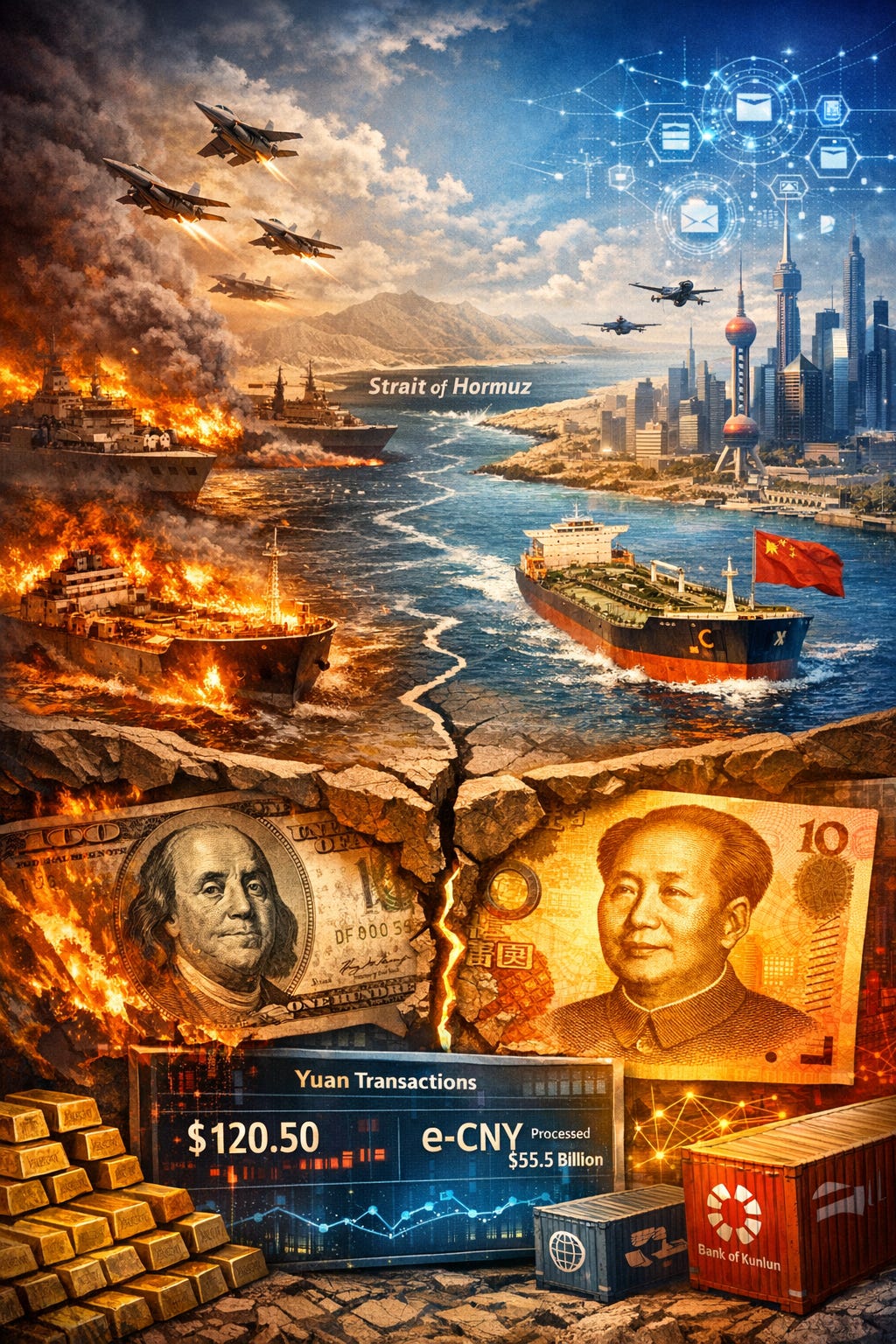
I. Introduction: The Ghost of 1974
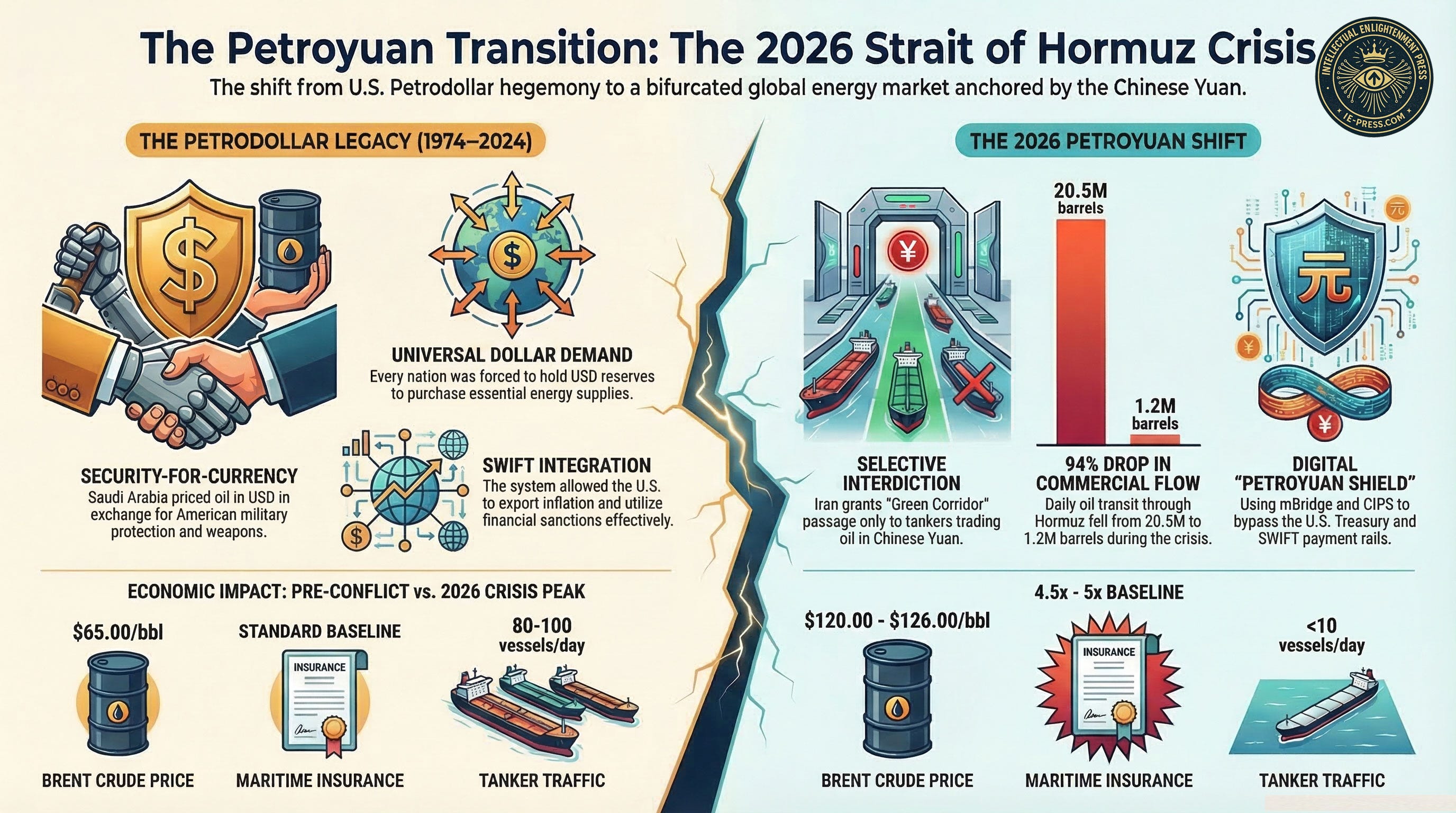
In June 1974, a discreet arrangement between Washington and Riyadh effectively anchored the global economy for half a century. Following the “Nixon Shock”, the 1971 termination of the dollar’s gold convertibility, and the subsequent 1973 oil embargo, the U.S.-Saudi Arabian Joint Commission on Economic Cooperation established a “security-for-currency” pact. The terms were simple yet transformative: Saudi Arabia would price its oil exclusively in U.S. dollars and recycle those surpluses into U.S. Treasuries; in exchange, America provided a total security guarantee. The details of this arrangement were so sensitive they remained classified until 2016.
This birthed the “Petrodollar,” a system that forced every nation to hoard greenbacks to keep their lights on. But by early 2026, this foundation has not just fractured, it has been replaced by a chaotic reality where energy security and currency hegemony have been violently decoupled. A localized maritime dispute in the Middle East has metastasized into an existential threat to the dollar, revealing that while the U.S. can still win a naval battle, it is losing the war for the “invisible infrastructure” of global trade.
II. The Expiration of the “Security-for-Currency” Pact
The pillars of American economic hegemony reached a symbolic expiration point in mid-2024, marking exactly 50 years since the original joint commission. As the structural demand for the dollar shifted, Saudi Arabia began a measured pivot toward a multi-currency model, engaging in active discussions to price crude in yuan, euros, and yen.
This transition was rendered inevitable by the changing physics of global demand. China has emerged as the world’s largest oil importer, creating a gravitational pull for alternative payment systems that reflect physical commodity flows rather than 20th-century geopolitical loyalties. For decades, the U.S. enjoyed an “exorbitant privilege,” essentially exporting its inflation by requiring the world to hold its debt. Today, that privilege is eroding under the weight of a multipolar market where China acts as the economic guarantor for nations seeking to escape the “dollar trap.”
III. Operation Epic Fury: The Kinetic Catalyst
On February 28, 2026, the theoretical decline of the Petrodollar turned kinetic. A coordinated campaign of airstrikes, the U.S.-led “Operation Epic Fury” and the Israeli “Operation Lion’s Roar”, targeted Iranian leadership, resulting in the death of Supreme Leader Ali Khamenei. In the ensuing power vacuum, Mojtaba Khamenei seized control and implemented a strategy of “Selective Interdiction” in the Strait of Hormuz.
The paradox of the conflict became immediately apparent: while the U.S. military demonstrated absolute superiority by sinking seventeen Iranian naval vessels in the opening days, it could not stop the economic hemorrhage. The conflict is currently costing the U.S. Treasury nearly $900 million per day, even as the “invisible rails” of trade shift toward Beijing.
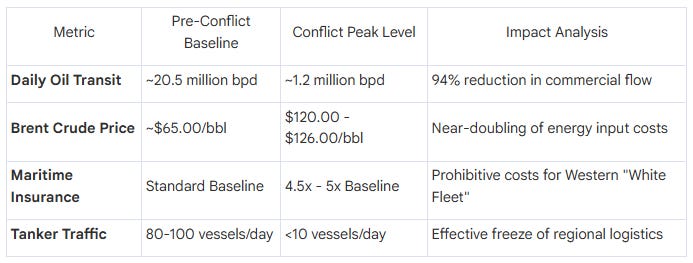
Metric of Disruption (March 2026)
In a masterful move of asymmetric financial warfare, Iran established a “Green Corridor.” While Western-linked vessels are targeted by low-cost drones, tankers bound for China are granted “Sovereign Immunity,” effectively turning Iran into the physical enforcer of a Chinese-centric trade route.
IV. The “Yuan Mandate”: Economic Warfare at the Chokepoint
On March 14, 2026, the crisis evolved from a blockade into a sophisticated reconfiguration of the global financial map. Iranian officials proposed a controlled reopening of the Strait, but with a singular, transformative condition: passage is permitted only for tankers whose cargo is traded in Chinese yuan.
This created a “Bifurcated Oil Market.” International buyers now face a binary choice: comply with U.S. financial regulations and suffer a catastrophic energy shortage, or embrace the yuan to secure safe passage. This “Yuan Condition” is a direct attempt to dismantle the foundational pillars of American financial power. It introduces a two-tier pricing system: a “War Premium” for those clinging to the dollar, and a “Safety Discount” for those willing to settle on Chinese rails.
V. The Petroyuan Shield: Dark Fleets and Digital Rails
To maintain this system under the pressure of maximum U.S. sanctions, a “Petroyuan Shield” has been deployed, a fusion of maritime evasion and digital settlement.
Geospatial Displacement: Following the targeting of the Kharg Island terminal by U.S.-Israeli forces, the Goreh-Jask pipeline and the Jask Oil Terminal became critical. By loading oil south of the Hormuz chokepoint, Iran has moved the “Point of Sale” outside the immediate kinetic impact zone.
The “Dark Fleet”: A fleet of tankers utilizing “Sanctuary Jurisdictions” and Synthetic Aperture Radar (SAR) to circumvent Western detection, ensuring that 12 million barrels have already reached China despite the blockade.
CIPS & e-CNY: The Cross-Border Interbank Payment System and the digital yuan provide a closed-loop settlement layer, neutralizing the U.S. Treasury’s ability to freeze assets or monitor transactions.
Bank of Kunlun: Acting as the primary settlement hub, this institution maintains the liquidity of the Iranian security state, entirely insulated from the SWIFT network.
VI. mBridge: The “Strategic Surrender” of Western Finance
The technical backbone of this new order is Project mBridge, a blockchain-based platform for multi-central bank digital currencies. While Western finance remained tethered to legacy systems, the “mBridge Ledger” was built to handle the rails of 21st-century commodity trade. Analysts describe this as a “strategic surrender to Chinese financial technology.”
The Displacement of SWIFT:
Traditional SWIFT (The Legacy Model): 2–5 days for settlement; high costs via intermediaries; full visibility for the U.S. Treasury; high sanction risk.
mBridge (The Sovereign Digital Infrastructure): Real-time, peer-to-peer settlement; 50–70% lower transaction costs; encrypted and decentralized to reduce sanction vulnerability.
By November 2025, mBridge had already processed over $55.5 billion in transactions, with the digital yuan accounting for 95% of the volume. This platform allows the UAE and Saudi Arabia to continue trading with Asia while bypassing the volatility and political risks of the dollar-denominated world.
VII. Conclusion: A World of Two Suns
The 2026 crisis signals the end of the unipolar financial era. The 20th-century model of “security-for-currency” is being replaced by a 21st-century “commodity-for-digital-settlement” model. In this new landscape, the Petrodollar and the Petroyuan now coexist as two competing suns in a fragmented sky.
The events in the Strait of Hormuz have proven a bitter truth for the West: military superiority can clear a sea lane, but it cannot force a merchant to use a specific ledger. As the U.S. spends $900 million a day to maintain a presence in the Gulf, the “invisible infrastructure” of global trade has already migrated to a system where Washington has no jurisdiction. We have entered a world where the power to close a trade route is significant, but the power to redefine the currency of that trade is absolute. The question is no longer whether the Petrodollar will survive, but how the West will adapt to a world where it is no longer the only game in town.


