


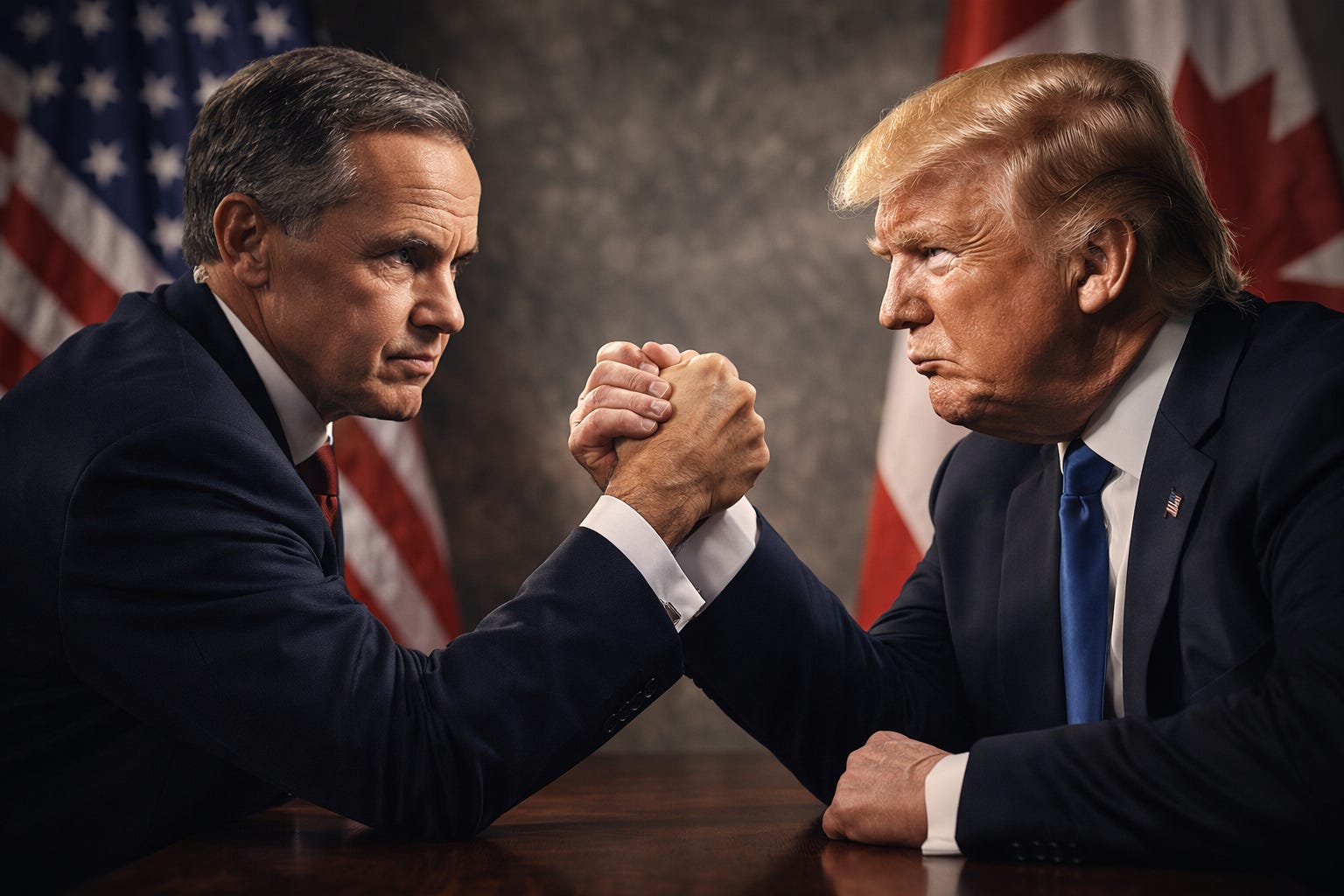
The bilateral relationship between the United States and Canada, long celebrated as the most integrated and stable economic partnership in modern history, reached a point of systemic failure in March 2026. This collapse was precipitated by Canadian Prime Minister Mark Carney’s categorical rejection of a comprehensive suite of trade demands issued by the administration of Donald Trump. This event is not an isolated trade skirmish but represents the formal dismantling of a $1.6 trillion annual trade relationship, a development described by geopolitical analysts and the Canadian government as a “rupture in the world order”.
The rejection of these demands has effectively placed the United States-Mexico-Canada Agreement (USMCA) on a path toward termination or expiration, signaling the end of the post-1945 era of North American economic exceptionalism. Prime Minister Carney, drawing on a distinguished career as the former Governor of both the Bank of Canada and the Bank of England, has pivoted Canada toward a strategy of “strategic autonomy”. This strategy seeks to decouple Canadian prosperity from American political volatility by constructing a “Middle Powers Economic Partnership” (MPEP) and diversifying trade toward Europe, Asia, and emerging markets.
The Genesis of the 2026 Crisis: The Five Demands
The current crisis escalated rapidly following a high-stakes negotiating window in early March 2026. President Trump presented a list of five structural, non-negotiable demands as prerequisites for the U.S. to agree to the renewal of the USMCA during its mandated six-year joint review, scheduled for July 1, 2026. These demands were designed to fundamentally reshape the Canadian economy to align with the “America First” industrial policy, seeking to extract concessions that the Canadian government deems violations of national sovereignty.
Analysis of the Structural Demands
The demands targeted specific pillars of the Canadian social and economic contract, ranging from agricultural protections to energy security and digital sovereignty.
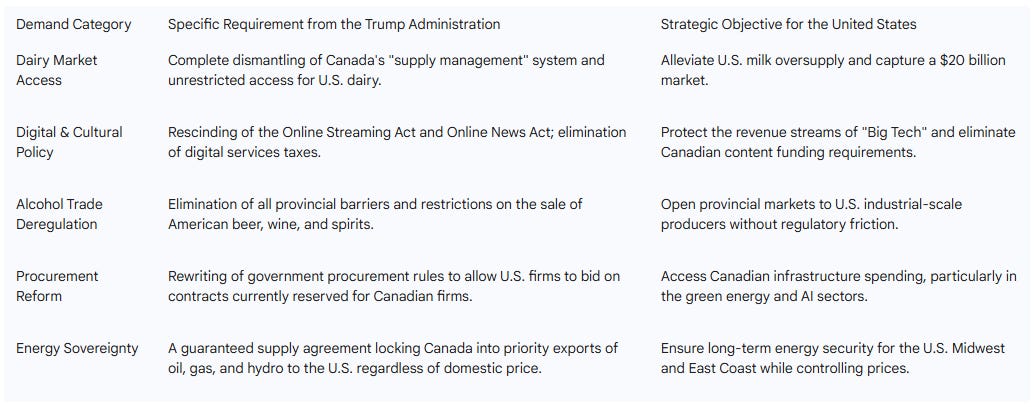
Prime Minister Carney’s refusal to negotiate on these points was a calculated move based on the assessment that the demands were “politically impossible and economically trivial” in the context of the total trade relationship. For instance, the Canadian dairy industry, while a frequent target of American rhetoric, represents only 1.25% of the total trilateral trade volume. The Carney administration argued that dismantling the system would destroy rural communities for a negligible gain in overall trade balance, a trade-off that no sovereign nation could accept.
The Carney Doctrine: From Dependency to Strategic Autonomy
The rejection of the Trump administration’s demands was not a reactionary posture but the execution of a long-term strategic plan initiated when Carney took office in early 2025. The “Carney Doctrine” is built on the premise that the American rules-based order has ended and that Canada must navigate a world where the United States is no longer a reliable partner.
The Financial Architect’s Perspective on Leverage
Carney’s background as a central banker in two G7 nations provides him with a unique understanding of risk and leverage in global financial systems. His strategy reflects a “masterclass in geopolitical chess,” recognizing that the United States is more dependent on Canadian inputs than the current administration acknowledges. Canada’s response to the 2025-2026 trade war has focused on demonstrating this dependency while building redundant trade pathways.
The Middle Powers Economic Partnership (MPEP)
A cornerstone of the Carney strategy is the formation of the Middle Powers Economic Partnership (MPEP), intended to unite “rules-restoring” democracies against the coercive use of trade as a weapon. Carney envisions this partnership as a “bridge” between existing agreements, specifically the Comprehensive Economic and Trade Agreement (CETA) with Europe and the Comprehensive and Progressive Agreement for Trans-Pacific Partnership (CPTPP) in Asia.
This proposed bloc would encompass approximately 1.5 billion people and represent an economic impact of $30 trillion. By positioning Canada as the only nation that is a member of both major agreements, Carney has created a platform for Canada to serve as a global trade hub that bypasses American-centric supply chains.
Diversification and the Pivot to Global Markets
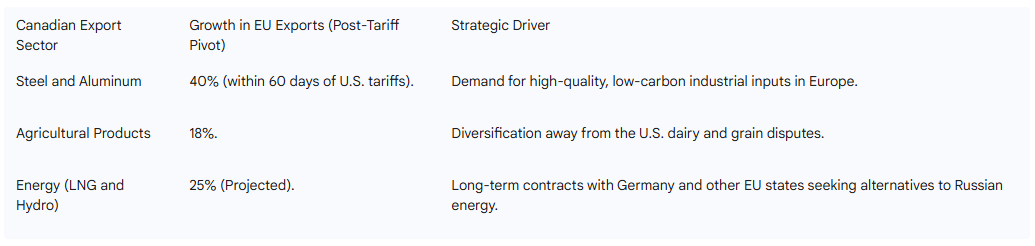
The efficacy of the Carney strategy is evidenced by the rapid reorientation of Canadian exports over the past 18 months. While 76% of Canadian exports historically went to the United States, that number is declining as Canada “turbocharges” its relationships with other global powers.
The European Expansion (CETA)
The revitalization of CETA has led to a 22% increase in Canadian exports to the European Union within a single year. Prime Minister Carney’s government prioritized the removal of administrative barriers and the streamlining of customs processes, allowing Canadian firms to pivot from American to European markets with unprecedented speed.
The Asian and Indo-Pacific Strategy
Simultaneously, Canada has expanded its reach into Asia through the CPTPP and new bilateral agreements. Prime Minister Carney’s recent high-stakes diplomatic missions to India, Japan, and South Korea have resulted in significant trade commitments.
India-Canada CEPA: The restart of negotiations for the Comprehensive Economic Partnership Agreement (CEPA) aims to double bilateral trade to $70 billion by 2030. This includes a $1.9 billion uranium supply deal, marking a shift in India’s energy procurement strategy toward Canadian stability.
Japan and South Korea: Agreements to expand LNG trade and strengthen supply chains for critical minerals used in semiconductors and EV batteries.
China Reset: A pragmatic “values-based realism” approach led to a deal where Canada lowered tariffs on Chinese EVs in exchange for China lowering tariffs on Canadian canola, unlocking nearly $3 billion in Canadian exports.
The Energy Weapon: Reversing the Flow of Leverage
The United States’ belief that it holds the upper hand in energy negotiations is challenged by the physical realities of refining infrastructure and Canada’s new export capabilities.
The Refining Dependency
The United States imports approximately 4 million barrels of oil per day from Canada, representing more than half of its total oil imports. Crucially, this is primarily heavy crude. American refineries, particularly in the Midwest and Gulf Coast, are specifically configured to process this heavy feedstock. Switching to light crude from domestic U.S. sources would require billions of dollars in retrofitting and years of down-time.
By signing long-term LNG deals with Germany and Japan, Carney has demonstrated that Canada is no longer a “captive supplier” to the American market. If the Trump administration follows through on threats to tax or block Canadian energy imports, Canada has the legal and infrastructural framework to redirect supply to energy-starved allies in Europe and Asia, leaving American consumers to face immediate price spikes at the pump.
The Hydroelectric Connection
The northern United States—including New York, Michigan, and Minnesota—depends on Canadian hydroelectricity to maintain grid stability and meet climate commitments. The Carney administration has signaled that this supply is no longer guaranteed under a scenario where the U.S. withdraws from the USMCA. A disruption in hydroelectric exports would force U.S. utilities to rely on more expensive and carbon-intensive natural gas plants, raising electricity bills for millions of American households.
Retaliation Mechanics: The Strategy of Targeted Political Pain
A key element of the 48-hour standoff in March 2026 was the realization by the Trump administration that Canada had successfully weaponized the political geography of the United States. Instead of broad tariffs, the Carney government implemented “targeted political pain,” focusing on products from states and districts represented by key Republican leaders.
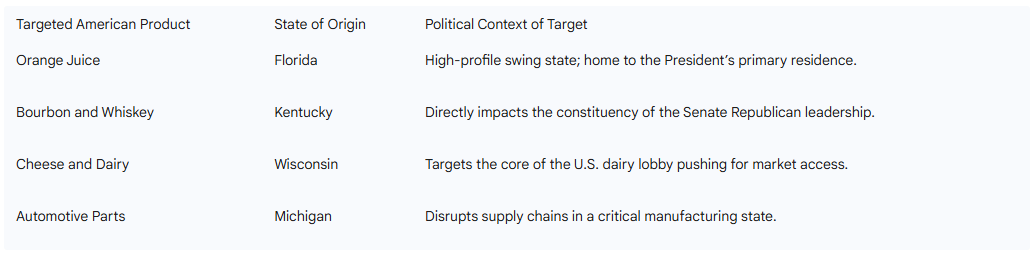
This strategy was proven effective during the steel and aluminum tariff skirmish of early 2025. When the U.S. imposed a 25% tariff on Canadian steel, Canada’s immediate retaliation on these specific goods, combined with the successful pivot of Canadian steel to Europe (+40% growth), forced the U.S. administration to “blink” and quietly reduce the tariffs by late March.
The Systemic Risks of USMCA Withdrawal
If President Trump initiates a formal withdrawal from the USMCA—as he has threatened to do following Carney’s rejection of his demands—the economic consequences would be devastating for the North American manufacturing sector.
Integrated Supply Chain Collapse
The USMCA governs $1.6 trillion in annual trade that is deeply integrated. In the automotive sector, parts often cross the border up to eight times before a car is finished. A withdrawal from the agreement would immediately subject every cross-border transaction to tariffs, increasing the cost of manufacturing in the United States and making U.S.-made products less competitive globally.
American companies would be faced with three difficult choices:
Absorb the tariff costs, leading to reduced margins and potential layoffs.
Pass the costs on to consumers, driving inflation and reducing domestic demand.
Move production facilities to Canada or Mexico to maintain duty-free access to other global markets through CETA and the CPTPP.
Agricultural Devastation for the U.S. Heartland
American agriculture is perhaps the most vulnerable sector to a USMCA collapse. Canada and Mexico are the top two export markets for American farmers. If the U.S. withdraws, American farmers would lose duty-free access to Canadian consumers while their Canadian counterparts continue to trade freely with Europe and Asia. This would result in a permanent loss of market share for U.S. corn, soy, and dairy producers, who are already struggling with the costs of the 2025-2026 trade war.
Financial Implications and the End of the Rules-Based Order
The most profound impact of the Carney-Trump rupture may be the damage to the “American rules-based international order”. In his Davos speech, Prime Minister Carney argued that the use of treaties and financial infrastructure as tools of coercion has undermined the global trust that sustains the U.S. dollar’s status as the reserve currency.
The Threat to the US Dollar
If the United States demonstrates that its word means nothing and that it will tear up long-standing treaties for political convenience, other nations have little incentive to hold U.S. Treasury bonds or rely on the dollar for international settlement. We are already witnessing the beginning of this shift as “Middle Powers” like Canada, Australia, and South Korea coordinate on energy security and digital standards outside of the U.S. framework.
The “rupture” Carney described in January 2026 is no longer a warning; it is a description of the current state of global trade. Canada’s strategy of “values-based realism” and the formation of the MPEP represent the first major institutional response to a world where the United States has abandoned its role as the guarantor of the global trading system.
Technical Assessment: Trade Elasticity and Economic Impact
The total economic impact of the USMCA collapse can be quantified through the relationship between tariff levels and trade volume. Using a standard trade elasticity model, the impact of a broad-based 25% tariff on the $1.6 trillion relationship can be estimated.

This calculation suggests that a move to full tariffs would result in a $600 billion reduction in annual trade, a contraction that would likely trigger a synchronized recession in both the United States and Canada. However, the “Carney pivot” aims to offset this by capturing a larger share of the $30 trillion MPEP market, a goal that appears increasingly feasible given the 22% growth in EU exports and the $70 billion target for India.
Conclusion: The New North American Reality
The rejection of President Trump’s demands by Prime Minister Mark Carney in March 2026 marks the end of an era. The $1.6 trillion US-Canada trade relationship is no longer a given; it is a “rounding error” in a broader global strategy of strategic autonomy.
Canada has demonstrated that it has the financial leadership, the global alliances, and the energy leverage to resist American coercion. The Trump administration now faces a choice between backing down—making the President look weak to his base—or following through on withdrawal, which will cause massive, self-inflicted economic damage to the United States.
The American media may not be covering the story, but the rest of the world is watching. They are learning that the era of American dominance is over and that the “Middle Powers,” led by a former central banker who understands exactly where the leverage lies, are ready to build a new, rules-based world order without the United States. The collapse is not coming; it is already here, and the “expensive lesson” for America has just begun.


