


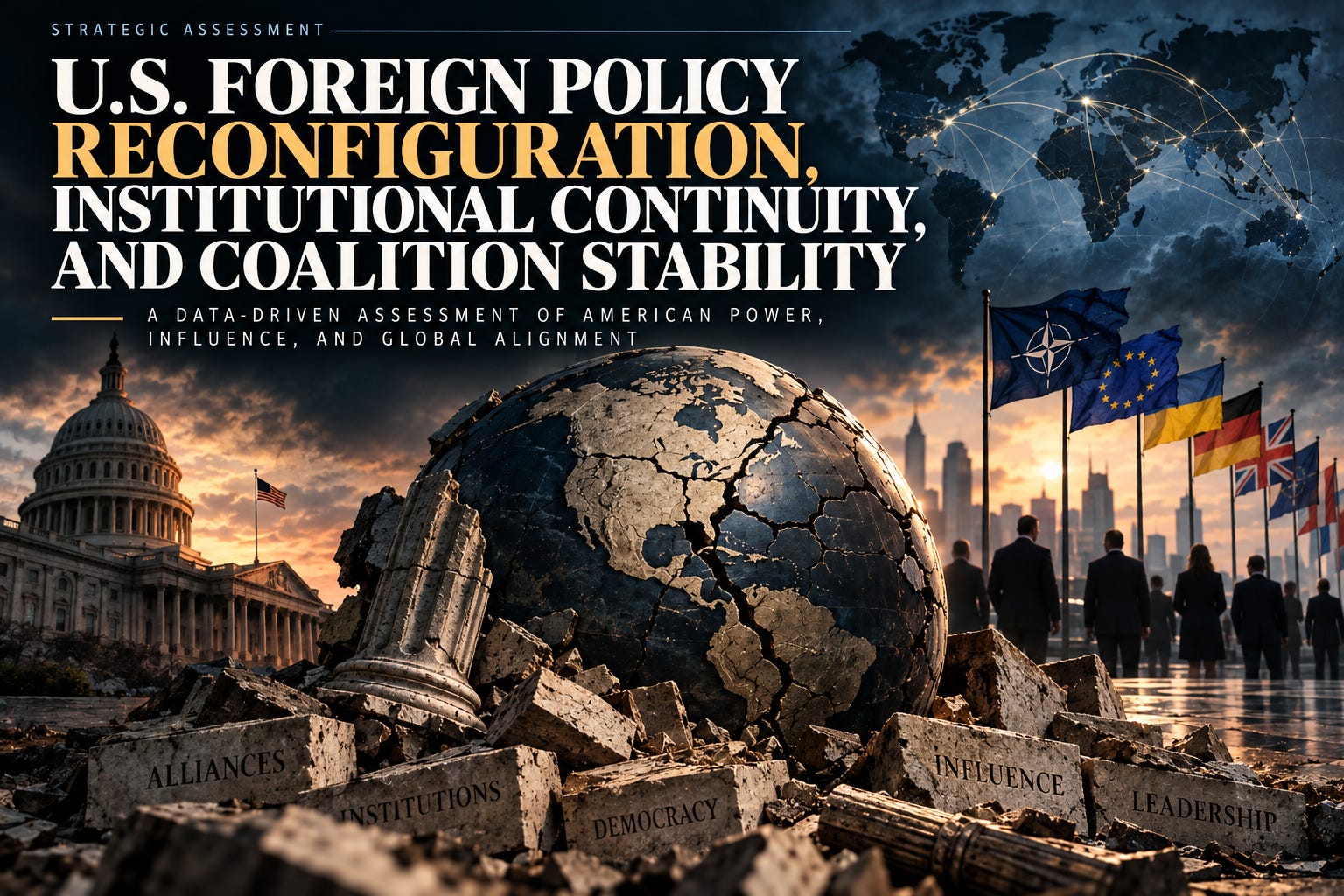
1. Conceptual Framework: Disentangling Strategic Power from Strategic Influence
Context & Strategic Importance
Following World War II, the United States occupied a unique position in global governance. It was not merely the world’s premier military and economic actor; it served as the principal architect and defender of an international system built upon durable alliances, formal multilateral institutions, integrated trade relationships, and a shared commitment to collective deterrence. While historic American leadership was often inconsistent—marked by military interventions, support for authoritarian regimes, and occasional departures from its stated principles—this institutional framework constrained rival powers and stabilized the international order.
Evaluating contemporary American power requires a strict analytical distinction between power (raw military capacity, financial reserves, technological base, and economic output) and influence (the capacity to persuade allies, forge consensus, and shape the institutional rules of international conduct). A state can retain elite hard-power capacity while simultaneously suffering an erosion in its ability to lead broad international coalitions. Disentangling hard capability from diplomatic persuasion is essential for evaluating global coalition stability, anticipating partner hedging behaviors, and assessing strategic vulnerabilities. The overarching thesis governing this assessment is that the primary threat to U.S. global standing is not foreign covert control or active foreign measures, but observable, self-induced strategic self-erosion caused by internal institutional realignments and unpredictable foreign policy shifts.
Methodological Ground Rules
To evaluate whether identifiable policy decisions diminish or enhance U.S. strategic posture, this assessment operates under six predefined research rules established in The Last Dominoes Measurement Framework:
Pre-established Indicators: Evaluation metrics and criteria are fixed prior to data synthesis across all policy domains to eliminate selection bias.
Symmetric Testing: Executive administration claims, including enhanced burden-sharing, leaner government, reduced censorship, and tougher trade terms, are tested using the exact same empirical standards applied to counter-indicators.
Structural Reform vs. Functional Capability: Structural changes (closing, merging, or restructuring an agency) are evaluated as administrative reorganizations (Confirmed) and are distinguished from operational capability outcomes. Functional capability decline is scored only when a specific operational output deteriorates without replacement (the “Bondi model”).
Historical Baselines: All indicators are evaluated against pre-2025 multi-administration baselines to distinguish immediate structural shifts from long-term secular trends or returns from temporary statistical peaks.
Separation of Decisions from Outcomes: Executive policy decisions are recorded as documented facts, whereas downstream causal outcomes are evaluated separately through dedicated empirical testing.
Distinct Measurement of Capacity vs. Persuasion: National power (hard capabilities) and strategic influence (persuasive coalition leadership) are rated independently across all functional domains.
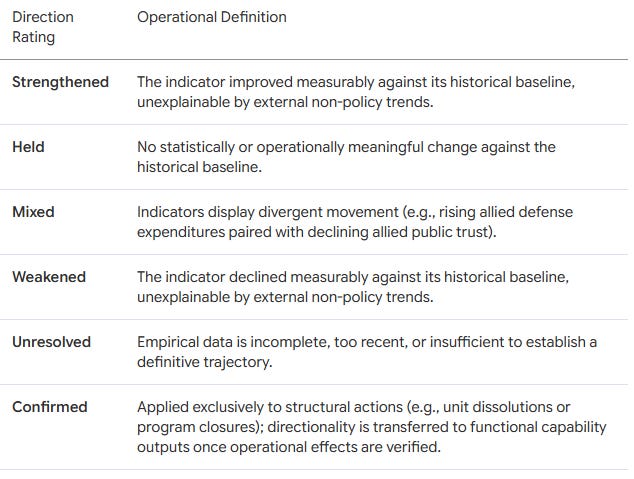
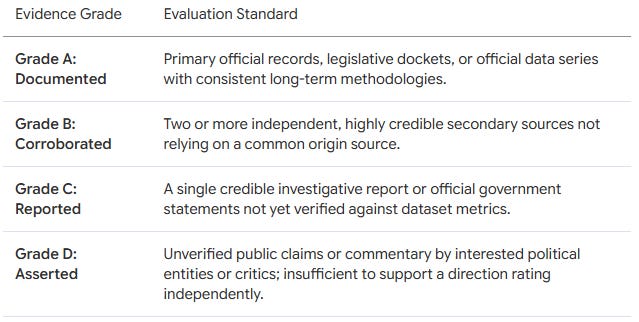
Analytical Metric Definition Table
The evaluation framework uses standard Direction Ratings and Evidence Grades to score incoming empirical data, ensuring methodological rigor and analytical transparency across the report.
Connective Tissue
Having established the conceptual and methodological foundation for measuring capacity alongside persuasion, this evaluation turns directly to Foundation 1: the empirical trajectory of U.S. security alliances and collective deterrence commitments.
2. Alliances and Security Commitments: Burden-Sharing vs. Deterrence Credibility
Context & Strategic Importance
Collective security arrangements, chief among them the North Atlantic Treaty Organization (NATO), serve as key force multipliers for American power. The ultimate deterrent value of an alliance rests not only on physical troop deployments and material stockpiles, but on political credibility, the unshakeable conviction among potential adversaries that an attack against one member will trigger an immediate, unified response. A fundamental tension has emerged between domestic political demands for European burden-sharing and the geopolitical necessity of maintaining credible, predictable deterrence against opportunistic foreign aggression.
Evaluating NATO’s Dual Trajectory
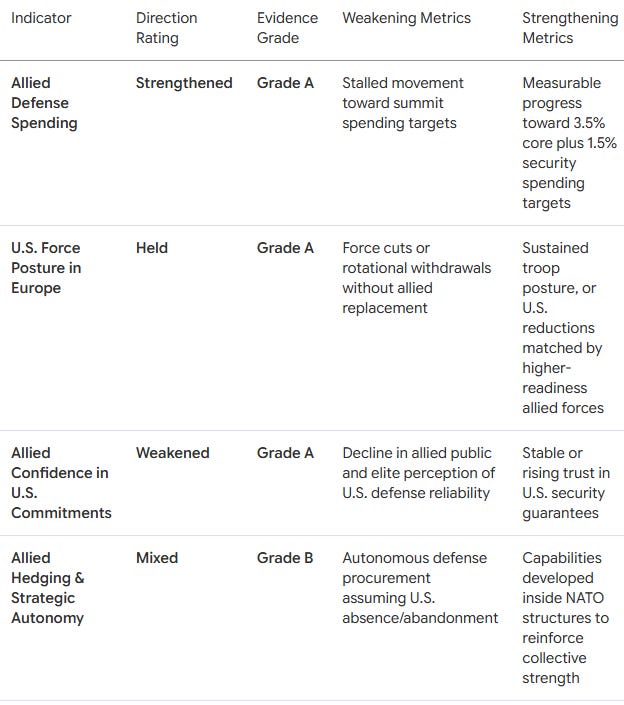
The trajectory of transatlantic security exhibits a clear operational divergence between military capacity and political influence. On one track, intense U.S. pressure for allied burden-sharing has yielded significant quantifiable increases in European defense investments. At the 2025 NATO Hague Summit, member states reaffirmed their collective defense commitments and formally adopted targets requiring member nations to progress toward the 5% aggregate GDP benchmark, comprising 3.5% of GDP for core military requirements plus an additional 1.5% of GDP for broader security-related spending by 2035. European allies have consequently expanded defense spending at rates unseen since the Cold War.
Concurrently, however, public framing of U.S. security guarantees as conditional or transactional has eroded partner confidence in American predictability during crises. While European militaries are becoming materially stronger, European leadership and citizenries express growing uncertainty regarding whether Washington would honor its Article 5 obligations during a high-intensity conflict. This divergence demonstrates that an alliance can expand its physical hard-power capacity while suffering a systemic decline in political cohesion and strategic alignment.
Indicator Assessment (Foundation 1)
Below is the structured evaluation matrix for Foundation 1: Alliances and Security Commitments, benchmarked against pre-2025 multi-administration baselines.
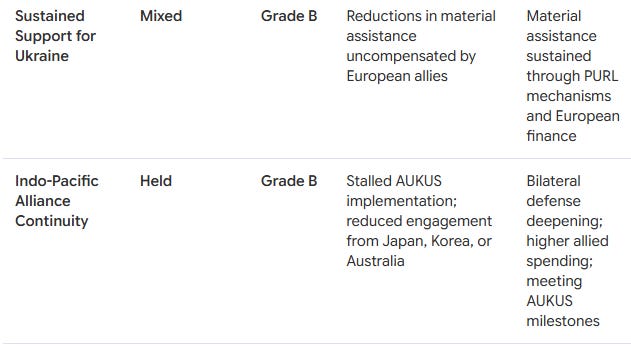
Analytical Assessment of “Allied Hedging”
The expansion of European “strategic autonomy” operates as a double-edged sword for U.S. global posture. On one side, European initiatives to build sovereign defense infrastructure, fund independent weapons development, and coordinate regional procurement directly fulfill long-standing American demands for burden-sharing. They reduce the direct military load on U.S. taxpayers and construct a robust regional bulwark against Eastern aggression.
Conversely, strategic autonomy inherently erodes American strategic centrality. As European states develop defense capabilities designed to function independently of American command structures, critical technologies, and political consensus, U.S. leverage over European foreign policy contracts. When European security architectures plan explicitly for potential U.S. absence or unpredictability, Washington forfeits its traditional ability to dictate alliance strategy, direct crisis parameters, or secure exclusive defense procurement contracts.
Connective Tissue
While hard-power deterrence within formal security treaties remains functionally operational despite political friction, a parallel evaluation of formal diplomatic channels, foreign assistance machinery, and soft-power instruments reveals deeper structural disruptions.
3. Diplomatic Reach, Soft Power, and International Institutional Continuity
Context & Strategic Importance
Formal diplomatic institutions, bilateral development programs, and multilateral organizations serve as essential force multipliers for national power. They enable a superpower to negotiate global standards, shape international regulatory frameworks, manage regional disputes, and build diplomatic consensus without resorting to coercion or costly military intervention. The systematically maintained presence of professional diplomatic personnel and targeted foreign assistance constructs enduring networks of access, trust, and leverage.
Deconstructing Institutional Restructuring
The institutional machinery of U.S. foreign policy underwent significant structural realignments beginning in 2025. A central administrative action was the absorption of the U.S. Agency for International Development (USAID) into the Department of State. A comprehensive Government Accountability Office (GAO) report issued in September 2026 documented that this structural merger caused widespread operational disruptions, marked by severe guidance weaknesses, administrative confusion, and significant reductions in program capacity across international development channels.
Simultaneously, traditional diplomatic representation experienced substantial staffing pressures. A May 2026 Reuters investigation revealed critical diplomatic vacancy rates across foreign missions, widespread career staffing reductions, and an increasing reliance on informal, personalized intermediaries to conduct state business. While the administration defended these realignments as necessary measures to streamline bureaucracy, eliminate redundancies, and align foreign policy strictly with executive priorities, the operational outcome was a measurable drop in diplomatic continuity, institutional memory, and predictive reliability in bilateral relations.
Soft Power and Global Public Opinion Matrix
Empirical metrics tracking global public attitudes highlight a sharp contraction in international trust and perceived American leadership credibility:
Global Leadership Confidence: A June 2026 Pew Research Center survey conducted across 36 countries revealed a median of just 23% of respondents expressing confidence in U.S. executive leadership regarding world affairs.
Perception of U.S. Reliability: Pew tracking recorded steep drops among core allied partner nations; most notably, the proportion of citizens in Canada viewing the United States as a reliable international partner fell from 83% in 2022 down to 35% in 2026. Across all surveyed countries, a median of only 35% believed the U.S. contributed to global peace and stability.
Institutional Mass Media Trust: Long-term Gallup tracking reveals a historic decay in domestic media trust—falling from 68% in 1972, to 40% in 2015, reaching a historic low of 28% in 2025, before a minor adjustment to 33% in September 2026. This systemic domestic collapse in media trust directly heightens overall public vulnerability to conspiracy narratives, manipulated media, and foreign active measures.
Long-Term U.S. Mass Media Trust Trend (Gallup Data)
1972: [==================================================68%]
2015: [====================40%]
2025: [==============28%] (Historic Low)
2026: [================33%] (Sept 2026)
Evaluating Multilateral Vacuums
The intentional strategic retreat or formal withdrawal of the U.S. from multilateral treaties and international bodies, such as the World Health Organization (WHO) and the Paris Climate Agreement, creates structural institutional vacuums. Institutional influence does not vanish when American diplomats vacate international forums; rather, sovereign rivals quickly occupy those vacated leadership roles. State actors such as China and Russia routinely leverage American absence to secure executive directorships in UN specialized agencies, draft international technical and legal standards, align voting blocs, and redirect global governance rules to favor autocratic governance models.
Connective Tissue
As formal diplomatic reach and international soft power contract under administrative restructuring and public trust deficits, domestic national security machinery, counterintelligence operational capabilities, and foreign-influence defenses face structural challenges of their own.
4. Intelligence, Counter-Foreign-Influence, and National Security Machinery
Context & Strategic Importance
A nation’s internal defense resilience relies heavily on its counterintelligence architecture, foreign influence mitigation capabilities, and institutional adherence to the rule of law. Protecting domestic political processes, critical technological supply chains, and sovereign infrastructure from sophisticated foreign state interference requires stable, non-partisan legal frameworks and sustained operational intelligence capabilities.
Case Study: The Bondi Decision Cluster Scorecard
Following the administrative directives issued on February 5, 2025 (the “Bondi decision cluster”), the Department of Justice (DOJ) underwent major structural realignments. Applying the principle of separating structural change from operational capability, the functional performance of U.S. national security capabilities is scored below:
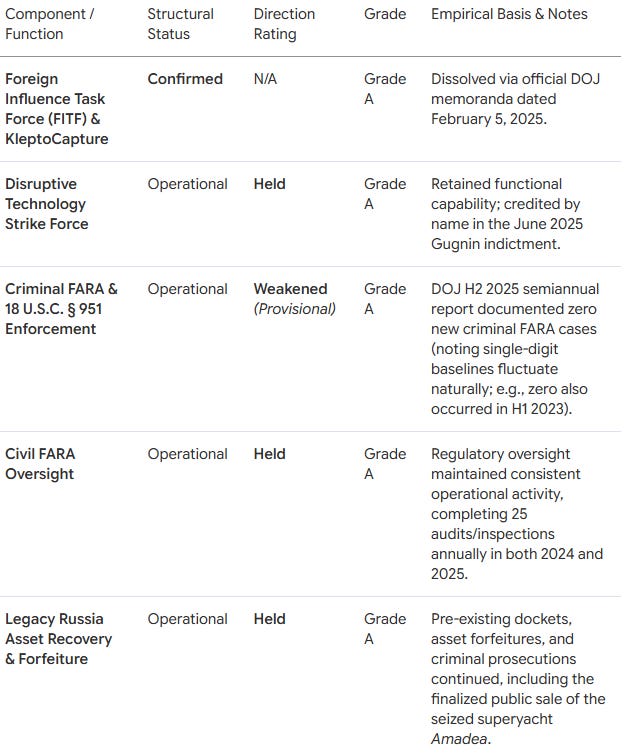

Assessment of Counter-Influence Capabilities
The dissolution of specialized threat-coordination entities, such as the Foreign Influence Task Force, altered the mechanism by which the U.S. counters active foreign measures. Executive directives refocused federal law enforcement away from domestic foreign-influence monitoring and toward traditional espionage, transnational criminal organizations, and border security/cartels.
While administration officials contend that this refocusing prevents law enforcement overreach, eliminates bureaucratic over-policing, and protects domestic political speech, counterintelligence metrics reflect potential strategic vulnerabilities:
Election Threat Warnings: Joint public threat advisories historically coordinated across the Cybersecurity and Infrastructure Security Agency (CISA), the Office of the Director of National Intelligence (ODNI), and the Federal Bureau of Investigation (FBI) experienced coordination delays and reduced output, altering inter-agency information sharing with state election officials.
Cyber Threat Advisories: Technical cyber advisories detailing foreign state-sponsored cyber operations decreased in frequency, altering the real-time dissemination of threat telemetry to private infrastructure operators.
Workforce Retention: Institutional shifts and inter-agency restructurings generated attrition among senior, experienced national security personnel, leading to a temporary loss of operational domain expertise across specific foreign influence portfolios.
Connective Tissue
An assessment of internal intelligence structures and foreign-influence defenses provides the necessary context for evaluating how foreign adversaries perceive American posture, calculate strategic opportunities, and align their foreign policies accordingly.
5. Adversary Exploitation and Strategic Alignment: Analyzing the U.S.-Russia Dynamic
Context & Strategic Importance
Understanding adversary behavior requires evaluating foreign opportunities independently of covert origin claims. An adversary foreign intelligence service does not need to possess covert operational control over a target state’s leadership to exploit its foreign policy adjustments. When a power experiences domestic polarization, administrative restructuring, or alliance friction, foreign adversaries adapt their strategy to leverage those vulnerabilities to advance their own longstanding strategic goals.
Analysis of Competing Hypotheses (ACH) on Policy Alignment
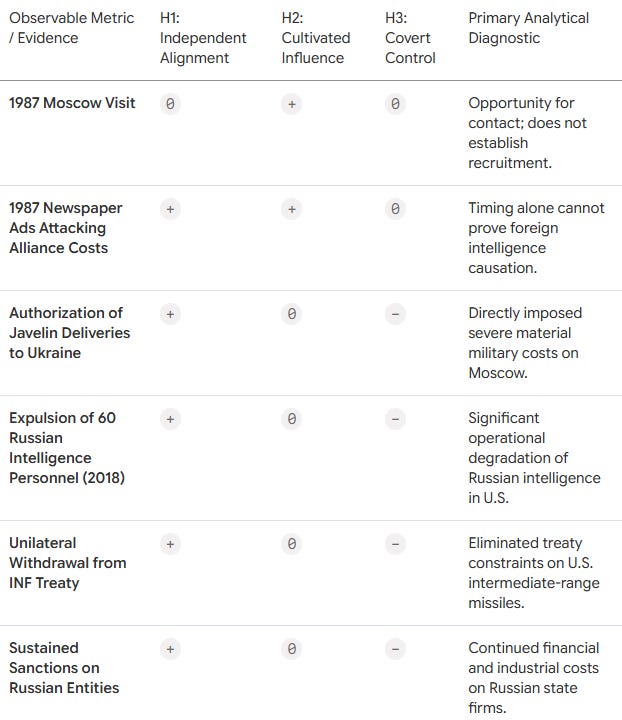
To analyze U.S. foreign policy alignment with Russian strategic interests, intelligence analytical methodologies utilize the Analysis of Competing Hypotheses (ACH), developed by CIA analyst Richards Heuer. Rather than gathering evidence to confirm a preferred narrative, ACH systematically evaluates observable evidence against mutually exclusive explanations:
H1: Independent Alignment: U.S. foreign policy adjustments stem from long-held political convictions, transactional bargaining styles, and domestic political incentives. Alignment with adversary preferences is coincidental and independent.
H2: Cultivated Influence: Foreign intelligence services identified and target-cultivated key political figures or surrounding networks over decades, exploiting existing ideological preferences without establishing formal operational command.
H3: Covert Control (The “Krasnov” Allegation): Direct operational direction or coercion, as alleged by former Kazakh intelligence chief Alnur Musayev (who claimed Donald Trump was recruited in 1987 under the codename “Krasnov” and is controlled via a 100-volume paper kompromat file).
Below is the qualitative ACH matrix scoring observable actions against each hypothesis (++ strongly consistent, + consistent, 0 neutral, - inconsistent, -- strongly inconsistent, ? unverified):

Detailed Tradecraft Deconstruction of the Musayev Allegations
The allegation made by Major General Alnur Musayev (former Chairman of Kazakhstan’s KNB) that Donald Trump was recruited by the KGB in 1987 under the codename “Krasnov” represents a extreme version of Hypothesis 3. Subjected to rigorous intelligence tradecraft analysis, the allegation collapses under four major evidentiary contradictions:
Biographical Contradiction: Official published biographical reference works (including the definitive biographical registries compiled by historian Daniyar Ashimbayev) place Musayev in the Soviet Ministry of Internal Affairs (MVD) from 1986 to 1989. This directly contradicts Musayev’s personal claim of serving in Moscow within the KGB during 1987.
Jurisdictional Mismatch: Musayev explicitly asserts that the recruitment was conducted by the KGB’s Sixth Directorate. However, the Sixth Directorate was exclusively responsible for domestic economic counterintelligence—monitoring Soviet industrial state enterprises, foreign trade delegations, and foreign businessmen inside the USSR. Foreign intelligence operations and agent recruitment abroad fell strictly under the purview of the First Chief Directorate (FCD).
Lack of Direct Chain-of-Knowledge: Musayev offers no evidence of having personal access to the alleged 100-volume paper dossier, nor does he explain how an exile living in Austria since 2007 would possess real-time visibility into present-day Kremlin instructions or intelligence files.
Uncritical Reliance on Debunked News: In his detailed interview regarding motive, Musayev built a primary analytical claim around a news report asserting that Kash Patel visited Moscow in October 2026. This report was demonstrably false and officially corrected after federal law enforcement confirmed Patel was in Virginia. Musayev’s uncritical adoption of debunked media reports indicates a reliance on open-source news rather than primary intelligence channels.
Evaluating Policy Contradictions and the Unfalsifiability Fallacy
Hypothesis 3 (Covert Control) fails analytical testing when evaluated against historic policy actions that directly imposed severe material and strategic costs on Moscow:
                  HISTORICAL U.S. ACTIONS IMPOSING COSTS ON MOSCOW
                                (Contradicting H3)

 [Javelin Missiles]       [Skripal Poisoning]      [INF Treaty Exit]        [Economic Sanctions]
 Authorized direct       Expelled 60 Russian      Unilaterally exited      Imposed/expanded
 lethal anti-tank sales   diplomats/intelligence  the nuclear arms-control  financial-Industrial
 to Ukraine military.     officials in 2018.       framework.               sanctions targets.
When confronted with these actions, proponents of H3 typically dismiss them as deliberate “camouflage” or “decoy” measures sanctioned by Moscow. This analytical move introduces an unfalsifiability fallacy. Under standard intelligence Community Directives (ICD 203) and ACH methodologies, a hypothesis that treats both favorable and adverse evidence as proof of its own validity is logically unsound and must be rejected.
Deconstructing Adversary Signals: Putin’s September 2026 Address
In September 2026 (noting an unresolved transcript date discrepancy between September 16, 2026, and an alternate Kremlin transcript dated September 11, 2026, both falling between the Saxony-Anhalt and Mecklenburg-Western Pomerania state elections), Russian President Vladimir Putin delivered an eight-minute address. The speech focused heavily on Western strategic miscalculations, European energy inflation, NATO expansion, and German voter dissatisfaction.
Three competing hypotheses explain this analytical signal:
P1: Audience-Specific Messaging: Tailored rhetoric responding directly to a reporter’s question regarding German domestic politics.
P2: Perceived Strategic Opportunity: Capitalizing on transatlantic friction to pressure European political and economic cohesion.
P3: Perceived Strategic Victory: Viewing American leadership as fundamentally neutralized, shifting the decisive front line of the information war exclusively to Europe.
Rhetorical Omission Analysis: The most revealing element of Putin’s speech was what was absent: the address contained no direct attacks against the U.S. Executive leadership. Rather than framing Washington as the primary active adversary, Putin directed his political offensive entirely at European energy choices, voter dissatisfaction in Germany, and transatlantic cohesion. This rhetorical omission signals that Moscow may view the American front of the information war as effectively neutralized by internal U.S. political divisions, allowing Russia to shift its primary decisive effort directly to fracturing European political resolve.
Connective Tissue
Deconstructing adversary perceptions highlights the final analytical task: synthesizing these divergent threads—burden-sharing gains, institutional decay, adversary exploitation, and soft-power shifts—into a single evaluation of national power versus global influence.
6. Strategic Assessment & Synthesis: The Paradox of Power
Context & Strategic Importance
The ultimate test of foreign policy is whether tactical, transaction-based gains augment or degrade a superpower’s enduring capacity to maintain international order. A state that prioritizes short-term transactional concessions over stable systemic leadership risks altering the foundations of its own global influence.
Synthesis of Strategic Trade-offs
Contemporary U.S. foreign policy demonstrates a central strategic paradox. On one side, aggressive bilateral bargaining has produced quantifiable tactical gains: allied states are allocating unprecedented capital toward national defense spending (advancing toward the 5% aggregate GDP benchmark, comprising 3.5% core military and 1.5% security spending by 2035 established at the 2025 Hague Summit), regulatory regimes are being streamlined, and bilateral trade negotiations have yielded specific concessions.
On the other side, these tactical achievements coincide with a systematic decay in institutional predictability, diplomatic soft power, and alliance trust. The primary threat to U.S. global preeminence is not foreign active measures or covert control, but self-induced strategic self-erosion. The “Domino Sequence” hypothesis illustrates how domestic institutional decay converts directly into regional insecurity abroad:
                     THE STRATEGIC "DOMINO SEQUENCE" HYPOTHESIS

 [Declining Domestic]    [Intensified Political]    [Unpredictable Foreign]
 [ institutional    ] -> [   Polarization      ] -> [ Policy Trajectory   ]
 [   Reliability    ]                                       |
                                                            v
 [Expanded Adversary]    [ Weakened Coalition  ]    [ Allied Strategic    ]
 [ Operational Space] <- [      Cohesion       ] <- [ Hedging & Autonomy ]
When international allies conclude that U.S. commitments are contingent upon volatile domestic political cycles, they execute strategic hedging strategies—building autonomous procurement networks, establishing independent diplomatic channels, and diversifying security relationships. This hedging shrinks U.S. diplomatic leverage, fragments alliance alignment, and creates operational entry points for strategic rivals like Russia and China to exploit.
Final Key Takeaways
Capability vs. Persuasion Disconnect: The United States maintains premier hard-power capabilities—unrivaled military power, immense financial assets, a dynamic technology sector, and global currency dominance. However, its diplomatic influence—the persuasive capacity to build international consensus, lead coalitions, and shape global standards—has experienced a documented decline across traditional allied nations.
Causation vs. Exploitation Distinction: Foreign adversaries did not generate domestic political polarization, institutional distrust, or transatlantic trade frictions in the United States. However, sophisticated adversary intelligence architectures actively exploit these self-induced political divisions and policy adjustments to undermine collective Western resistance.
The New Battlefield: The primary threat to modern Western coalition security does not stem from a sudden collapse in hard military capabilities or industrial capacity. It lies in the decay of political willingness, institutional continuity, and mutual trust required to execute collective defense against foreign coercion.
Final Concluding Statement
A superpower can retain unmatched military hardware, economic reserves, and global technology platforms while losing the ability to command global leadership. When international partners lose faith in the predictability of American commitments, and when domestic citizens no longer accept common institutional mechanisms for establishing shared facts, national power becomes difficult to project effectively. Ultimately, influence depends on trust—and in a global environment defined by systemic geopolitical competition, the loss of alliance trust degrades strategic posture far faster than any dynamic on a conventional battlefield.


