


By HASE Fiero | IE Press — Information Warfare
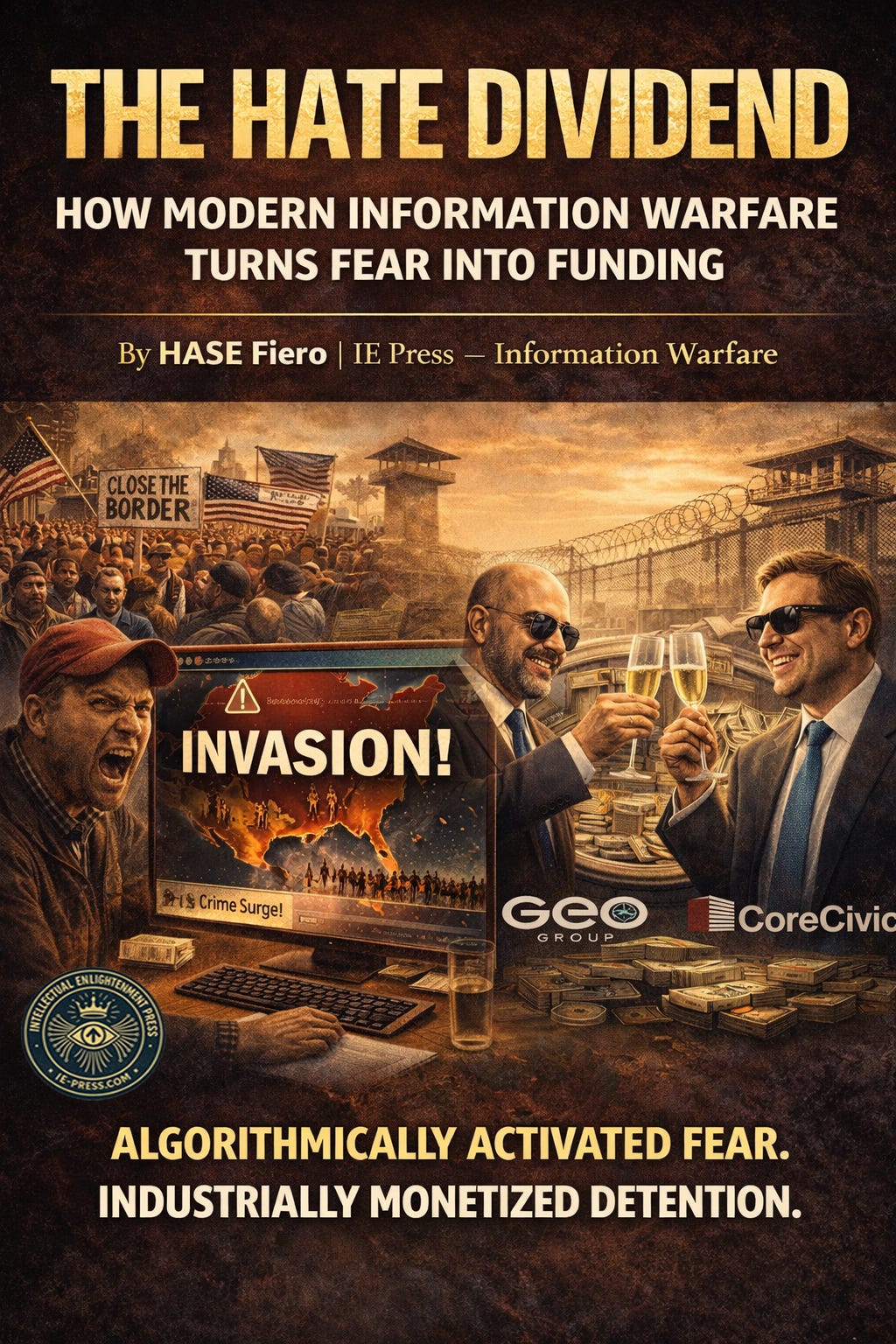
There is no need for secret meetings in smoke-filled rooms.
There is no master conspiracy memo.
The system runs on incentives.
The old Southern Strategy was geographic. It targeted a region. It coded its language. It whispered.
Today’s strategy is algorithmic. It does not whisper. It saturates.
Immigration has become the most efficient emotional ignition device in American politics — not because it is simple, but because it is visceral. Borders are tangible. Identity is tangible. Fear is tangible.
And fear is monetizable.
Step One: Manufacture Permanence
Information warfare does not require falsehood. It requires framing.
Every system needs a crisis to justify expansion.
A temporary emergency produces temporary funding.
A permanent emergency produces permanent industry.
So the language evolves:
Not “policy debate,” but “invasion.”
Not “migration,” but “threat.”
Not “administrative backlog,” but “collapse.”
When the public perceives an ongoing existential danger, appropriations become inevitable.
Congress allocates billions.
Agencies scale.
Infrastructure multiplies.
The narrative primes the ground.
The budget plants the steel.
Step Two: Convert Emotion Into Architecture
The genius of modern information warfare is not persuasion.
It is activation.
Activation drives turnout.
Turnout drives mandates.
Mandates drive funding.
Funding drives contracts.
And contracts drive profit.
The deportation apparatus did not materialize by accident. It was legislated into permanence — billions allocated across multiple fiscal years, detention capacity scaled to five and six figures, facilities reopened, military bases repurposed.
What began as border enforcement has become a vertically integrated system:
Arrest
Detention
Transportation
Digital monitoring
Removal
Each layer billable.
Each layer contract-backed.
Each layer scalable.
This is no longer reactive governance.
It is industrial policy.
Step Three: The Emotional Engine
Let’s be clear.
You do not need the majority of the population to be hateful.
You need them to be anxious.
Economic insecurity.
Cultural displacement.
Institutional distrust.
These are accelerants.
Information warfare weaponizes perception:
A single crime becomes a symbol.
A caravan becomes an invasion.
A budget line becomes national survival.
The algorithm does the rest.
Outrage spreads faster than nuance.
Fear travels farther than context.
Identity binds stronger than statistics.
The voter believes they are voting for safety.
The market understands it is investing in infrastructure.
Step Four: Follow the Cash Flow
Taxpayer dollars fund the machine.
Public appropriations pay per-diem rates for beds, transport contracts, monitoring systems, and facility reactivations.
Corporate balance sheets record the revenue.
Shareholders collect the margin.
The average taxpayer does not receive a dividend check from detention expansion.
They receive reassurance.
The capital class receives yield.
This is the quiet transfer embedded in the architecture:
Public risk.
Private reward.
Not unique to immigration — but uniquely visible when the “product” is confinement.
Step Five: The New Southern Strategy
The original Southern Strategy relied on coded racial politics. It exploited identity fractures to realign power.
Today’s version has evolved.
It is no longer confined to one region.
It is digitally distributed.
It is algorithmically amplified.
It does not require overt prejudice.
It requires polarization.
Half the country views enforcement as moral necessity.
The other half views it as moral failure.
The conflict sustains engagement.
Engagement sustains political intensity.
Intensity sustains appropriations.
This is not accidental.
It is adaptive.
Information warfare in 2026 is not about persuading the center.
It is about hardening the edges.
The Structural Question
Here is the uncomfortable arithmetic:
When enforcement expands,
When detention beds increase,
When contracts multiply,
When profits rise,
Is the system responding to crisis —
or sustaining it?
The question is not whether deportation is legal. It is.
The question is not whether borders require enforcement. They do.
The question is:
What happens when enforcement becomes an investable asset class?
When occupancy affects earnings calls,
When political rhetoric affects share price,
When federal funding becomes guaranteed revenue streams,
The line between governance and industry blurs.
Psychological Warfare at Scale
The Southern Strategy was political calculus.
Today’s information warfare is systems engineering.
Narrative → Activation → Mandate → Appropriation → Contract → Profit → Political reinforcement.
A closed loop.
No secret handshake required.
The system rewards whoever can maintain the perception of urgency.
And urgency, once industrialized, becomes self-perpetuating.
The Hate Dividend
Call it fear.
Call it identity defense.
Call it border security.
But understand this:
Emotional activation in a digitally amplified environment is not just political capital.
It is financial capital.
The people who feel the crisis most intensely rarely hold the equity.
That is the divergence.
Information warfare does not just move votes.
It moves money.
And when public emotion finances private margin, you are no longer looking at a policy debate.
You are looking at an industry.


