


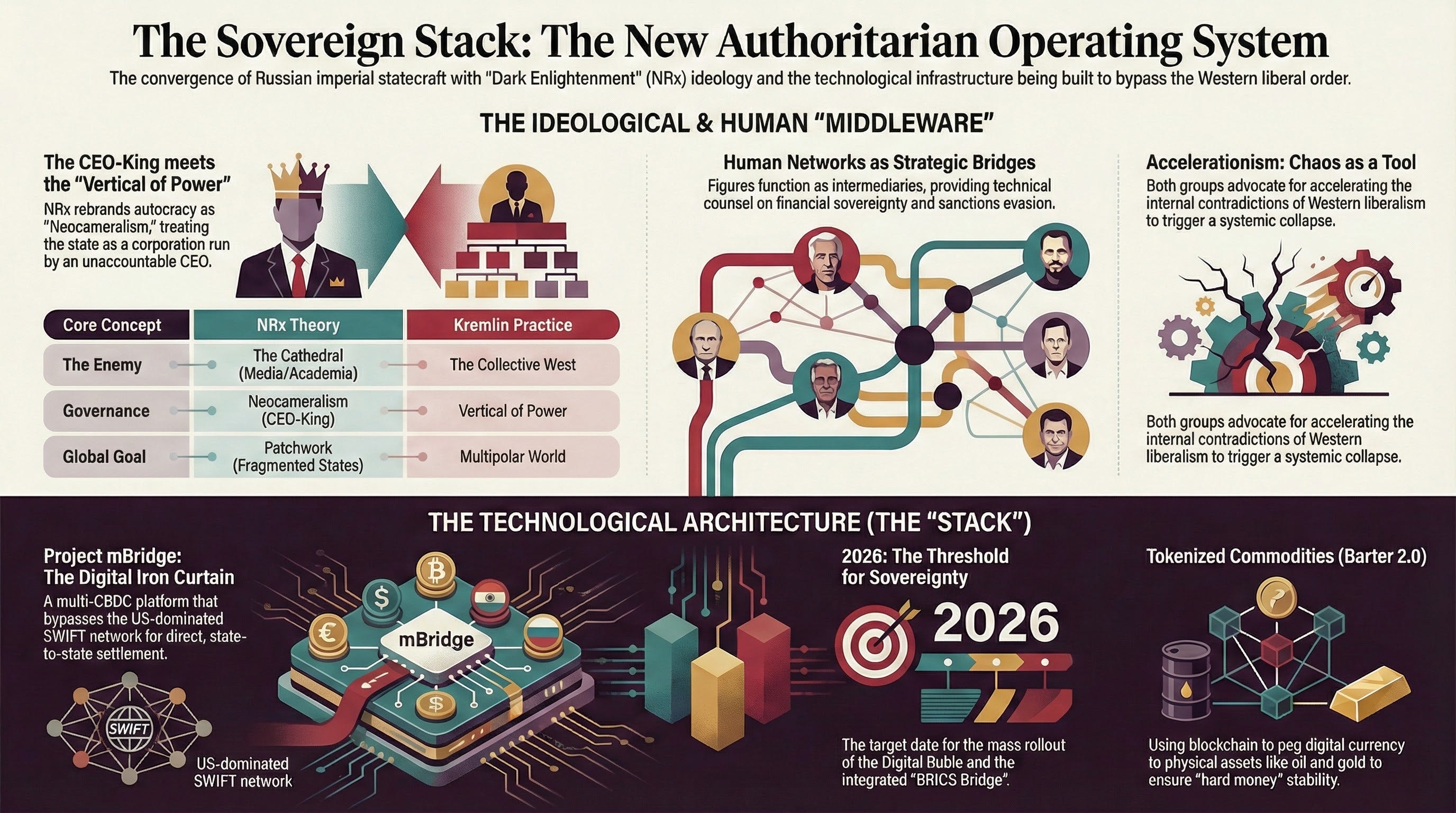
The Sovereign Stack: How Silicon Valley’s Darkest Philosophy Became the Kremlin’s New Operating System
The geopolitical architecture of the mid-21st century is undergoing a radical “re-platforming.” What began as an esoteric intellectual subculture in the libertarian fringes of Silicon Valley—the “Dark Enlightenment” or Neoreaction (NRx)—has evolved into a functional roadmap for the Russian state. This unlikely alliance between techno-optimist secessionists and Eurasian revanchists has produced the “Sovereign Stack”: a comprehensive suite of ideological, financial, and technological middleware designed to facilitate a protocol-level secession from the liberal international order.
The State as a Startup: The Rise of the CEO-King
The ideological core of this convergence is “Neocameralism,” a concept pioneered by NRx theorist Curtis Yarvin. Yarvin argues that democracy is a degenerative system prone to administrative entropy. His solution is to treat the state as a joint-stock corporation where “citizens” are reclassified as “customers” or “guests,” and the territory is managed by a “CEO-King.” This is not a regression to feudalism but a pivot toward “corporate efficiency,” where the sovereign has a vested, long-term interest in the realm’s stability.
This maps perfectly onto the “Vertical of Power” in “Russia Inc.” Unlike democratic leaders, whom Yarvin dismisses as mere “renters” or “caretakers” who loot the state for short-term electoral gain, modern autocrats like Vladimir Putin are framed as “owners” with equity in the nation’s survival. This framework transforms authoritarianism from a moral failing into a superior technological operating system.
“Democratic politicians are viewed as ‘renters’ or ‘caretakers’ who loot the state for short-term electoral gain because they have no equity in its long-term future. [Historical] absolute monarchs and modern autocrats are superior... because they have a ‘sovereign interest’ in the health of the nation, much like a CEO has in a company.”
The Epstein Blueprint: A Decades-Old Prophecy
The “Sovereign Stack” is not merely theoretical; it was operationally blueprinted as early as 2014. Evidence from leaked correspondence reveals that financier Jeffrey Epstein acted as a critical proto-intermediary for the Kremlin during the first wave of post-Crimea sanctions. Epstein provided Deputy Minister Sergey Belyakov with a sophisticated technical vision for sanctions evasion that effectively predicted the rise of “Petro-Tokens” and algorithmic finance by ten years.
Epstein’s advice was startlingly prescient, advocating for a “New Bank” model that rejected the “antiquated” constraints of the World Bank and IMF. He urged the Kremlin to develop “smart contracts” regulated by computers and proposed an alternative currency called “BRIC” years before the term became a staple of geopolitical anxiety. This was the first major instance of NRx-style “elite tech-financial” thinking being weaponized to grant a sovereign state “Exit” from the global financial protocol.
“Epstein urged Belyakov to reject the models of the World Bank and IMF, which he dismissed as ‘antiquated.’ Instead, he proposed a ‘New Bank’ modeled after a ‘capitalistic commercial bank’… capable of leveraging its reserves at a ratio of 9:1.”
Toppling “The Cathedral”: Weaponizing Anti-Liberalism
To defend its autocracy, the Kremlin has weaponized the NRx concept of “The Cathedral.” In NRx taxonomy, The Cathedral is the decentralized, non-theistic theocracy of Western academia, media, and bureaucracy that enforces a “progressive” orthodoxy. By adopting this framework, the Kremlin can strip Western soft power of its moral legitimacy.
Through this lens, international human rights NGOs and independent journalists are not altruistic actors but agents of a hostile ideological hegemon seeking to impose its “synopsis” on sovereign nations. This reclassification validates the Kremlin’s paranoia, allowing it to frame the suppression of dissent as a necessary act of defense against an invasive global theocracy.
The Digital Iron Curtain: Project mBridge and the “Exit”
The most potent layer of the Sovereign Stack is the technological infrastructure enabling a “Cold Divorce” from Western finance. Project mBridge—a multi-CBDC platform—and the Digital Ruble represent a “digital territorial fix” that renders US correspondent banks like JPMorgan irrelevant.
By utilizing “atomic swaps” on permissioned ledgers, the Kremlin can settle international trades (such as Digital Rubles for Digital Dirhams) instantly and directly. This process of disintermediation bypasses the SWIFT network and the OFAC chokepoint entirely. The 2024 withdrawal of the Bank for International Settlements (BIS) from mBridge signals the project’s “graduation” into a fully sovereign, weaponized tool. With a mass rollout scheduled for 2026, the Kremlin is nearing a threshold where its financial reality becomes permanently incompatible with the West.
Geopolitical Accelerationism: The Philosophy of Chaos
While the Kremlin seeks internal order, it exports chaos through “Geopolitical Accelerationism.” This strategy, influenced by the philosopher Nick Land, suggests that the contradictions of the liberal order should be accelerated until the system collapses.
Russia acts as a “chaos agent” not to offer a better alternative, but to fragment the West into a “Patchwork”—an NRx vision of a world broken into thousands of competing, sovereign city-states and corporate fiefdoms. By funding divisive movements and support for fringe theories, the Kremlin aims to dissolve supranational bodies like NATO and the EU into manageable, transactional bilateral units.
The Future of Walled Gardens
The emergence of the Sovereign Stack signals the definitive death of the 1990s “Global Village.” We are witnessing the rise of a “Gov-Corp” alliance—a bloc of nations including Russia, Saudi Arabia, and the UAE—that prioritizes “settlement finality” and absolute executive control over democratic norms.
These states are building “sovereign clouds” and digital intranets that embed national borders into the very code of the internet. As the world bifurcates into incompatible digital operating systems, citizens are increasingly treated as depoliticized “customers” within high-tech walled gardens. The era of a shared global reality is over; the era of the Sovereign Stack has begun.


